Mark Hoppus from Blink 182 and Rod Dreher, formerly of the American Conservative.


Mark Hoppus from Blink 182 and Rod Dreher, formerly of the American Conservative.
Guys, remember when the Syrian government was overthrown? Me neither! There have been so many awful and engrossing news stories since then––the wildfires in Los Angeles, the inauguration and the return of Trump, the global wars still raging––that my puny, addled brain can barely recollect the experience of reading the news the day Syrian rebels swiftly and easily captured Damascus.
But apparently my long-term memory is, unlike my short-term one, in decent shape, because whenever I hear the al-Assad name I think: how’s Joan Juliet Buck doing?
In case you missed it, here’s the background: Joan Juliet Buck was a well-respected if eccentric writer for Vogue who, in 2011, took an assignment from her editor to write a profile of Asma al-Assad, the British-born wife of then-Syrian president (he was president in 2011, when Buck profiled his wife, not when they met). In her retelling of this afterward, she was uneasy from the get-go. “Absolutely not,” she wrote in an essay for Newsweek. “I don’t want to meet the Assads, and they don’t want to meet a Jew.” Nevertheless, she said it was “more interesting” than her usual assignments profiling models and actresses, and she was eager to see the antiquities in Syria, so she went.
You can probably guess what happened next. Shortly after Buck’s article came out, the brutal Syrian Civil War began, during which al-Assad killed many Syrians. Scrambling for a justification for printing a glossy profile of a woman married to a mass murderer, Vogue threw Buck under the bus, even though anyone in or around publishing would––should––have recognized that the buck didn’t stop with her, and Vogue would have had to be complicit in many ways, if not the sole reason for such a misstep.
Regardless, Buck’s article vanished from the Internet, and her contract wasn’t renewed. As of 2017, she was living in a rented apartment in Rhinebeck, New York and working on her memoir from the basement of a local library.
I’ve long been curious about what happens to documents deemed no longer reliable because of social reasons, like this, or because they’ve been found unreliable due to plagiarism or authorial dishonesty. (For a long time, I was obsessed with wondering who would actively choose to read James Frey’s A Million Little Pieces post-Oprah debacle, and what that person’s experience of the book would be.) So naturally I went on Ebay to track down a copy of Vogue’s Power Issue from March 2011. (Don’t worry––it wasn’t that expensive.)
My first thought upon receiving it is how weird it was to hold a bulky magazine like this again, actually. Given how much we’ve moved away from print in recent years, and how most of the publications I now do read IRL are slim or literary journals (so therefore kind of thick but much smaller), I had a shocking jolt of recollection––I wouldn’t call it nostalgia, really, because it wasn’t entirely pleasant––when I flipped through what felt like dozens of pages of ads before I even got to the table of contents. As a person who can fetishize the analog, I was sort of surprised to find I didn’t actually miss this tactile experience.
At the time I purchased it earlier this year, you couldn’t find the article itself anywhere online, although a friend told me she’d heard Gawker had a copy up for a while. You could, however, find recounting of the debacle like this one, which quoted or paraphrased the piece in a few places, including the Guardian (here). Most of those articles about the article focused on the rather gauzy, Vogue-appropriate physical descriptions of the first lady, which play pretty, uh, poorly in retrospect. “[G]lamorous, young, and very chic… [A] thin, long-limbed beauty,” Buck calls the woman currently believed to be holed up in some opulent Moscow apartment.
I agree that a lot of her descriptions read as unsavory in the light of the present, but actually, the article isn’t as glowing as many of Buck’s detractors made it out to be. Right in the second paragraph, she calls out the assumption of Syria’s safety as based upon the fact that its government “conducts intense physical and electronic surveillance” of Syrians and foreigners alike. When the first lady feeds Buck a bunch of bromides about coexistence in Syria, Buck segues into a description of the desolate Jewish quarter in Damascus.
By far the weirdest and saddest thing in the piece is not Buck commenting on Mrs. al-Assa’s quiet luxury or whatever; it’s her description of their visit to one of the Massar centers, youth civic centers where kids are, on that day, learning music and chess on computers. Then:
“Asma al-Assad stands to watch a laborious debate about how–-and whether––to standardize the Arabic spelling of the word Syria. Then she throws out a curveball. ‘I’ve been advised that we have to close down this center so as to open another one somewhere else,’ she says. Kids mouths drop open. Some repress tears. Others are furious. One boy chooses altruism: ‘That’s ok. We know how to do it now; we’ll help them.”
Then the first lady announces, ‘That wasn’t true. I just wanted to see how much you care about Massar.’
As the pilot expertly avoids sheet lightning above the snow-flecked desert on the way back, she explains, ‘There was a little bit of formality in what they were saying to me… Tricks like this help––they became alive, they became passionate.’”
Tricking refugee children into believing a major source of support is about to disappear: this is jaw-droppingly insane! Buck touched upon this in her Newsweek piece, but it doesn’t pop up much elsewhere that I’ve seen, and I mean honestly, just getting that in there I think makes Asma come off really poorly. Am I wrong on this?
Anyway if you want to see the thing in full reach out to me, I’ll just scan this sucker and send it along!
As a lover of literature and writing, I still have to admit SBF has a point here.
“By high school Sam [Bankman-Fried] had decided that he just didn’t like school, which was odd for a person who would finish at the top of his class. He’d also decided that at least some of the fault lay not with him but with school. English class, for instance . His doubts about English class dated back to the sixth grade. That was when the teachers had stopped worrying about simple literacy and turned their attention to deeper questions. ‘As soon as English class went from ‘can you read a book’ to writing an essay about a book, I completely lost interest,’ recalled Sam. He found literary criticism bizarre: who cared what you felt or thought about a story? The story was the story, with no provable right or wrong way to read it. ‘If they said to talk about what you like or don’t like, okay, I would do that,’ he said. That’s not what they were asking him to do, however. They were asking him to interpret the book, and then judging him on this interpretations… “
“‘I objected to the fundamental reality of the entire class,’ said Sam of English. ‘All of a sudden I was being told I was wrong––about a thing it was impossible to be wrong about. The thing that offended me is that it wasn’t honest with itself. It was subjectivity framed as objectivity. All the grading was arbitrary. I don’t even know how you grade it. I disagreed with the implicit factual claims behind the things that got good grades.'”
~Michael Lewis, Going Infinite: The Rise and Fall of a New Tycoon
This is a two part series, subtitled “Things I’m Pretty Sure Are Fake But Can’t Prove,” which just about sums it up. This first one will be long, and the second, because it’s kind of a live issue, much shorter.
One of the things I used to write about a lot––like professionally, not really here as much––is the Sad Girl Lit of the 90s, including titles like Prozac Nation and Wasted . I can’t really say whether there’s a pipeline here, but my theory is one gateway drug to this genre is Sad Kid Lit. I don’t think this is a thriving genre anymore, but Sad Kid Lit were stories about “disturbed” (the parlance of the time) children with diagnoses like autism, trauma, elective mutism, and so on, often (but not always) written from the perspective of the healers who rescued them from this darkness. And the uncontested queen of this genre is Torey Hayden.
Hayden is a special education teacher, with a focus on elective mutism, who was born in Montana and worked largely in and around the Midwest and the Pacific Northwest, at clinics and in school settings. In 1980, she published her first book, One Child, about a little girl named Sheila who was a student of hers. Per the book synopsis, Sheila “never spoke, she never cried and her eyes were filled with hate.” But then Hayden put in extra time coaxing the girl out of her shell, including even saving her from her mother’s rapist boyfriend (IIRC––I haven’t read it in over twenty years), and then Sheila thrived (short version). The book was a big hit––it was reprinted as recently as 2016––and made Hayden at least somewhat famous. For some godforsaken reason, my teacher let me do an oral book report on it in the seventh grade, even though it included at least one episode of child rape. But hey, it was the nineties––things were different then.
Back in the day, I read a lot of Hayden thirteen books, except for the fiction ones, IIRC. They follow a fairly predictable pattern: Hayden enters a new environment––a new classroom, a new clinic, etc.––sees a “gem” underneath one child’s hardened or bewildering exterior (pity the poor average autistic child in her class!) and then the child is cured of his or her issues. The one that I remembered the best––nay, vividly––was called Ghost Girl: The True Story of a Child in Peril –- And the Teacher Who Saved Her. The setting this time is a small podunk town somewhere in a Plains state; Hayden has moved here, somewhat inexplicably, for a change of scenery after a stint at a clinic in a nearby larger city (she doesn’t use its real name, but it has an Omaha vibe)? She presides over a classroom of just a handful of children, one of whom is Jade Ekdahl, a selective mute who lives up the street from the school, who dresses in a slovenly way, has abhorrent posture (she’s described as being basically bent over at the waist), and is notorious for breaking the will of her previous teachers with her refusal to speak (the teacher just before Torey committed suicide, and it’s heavily implied it was because she was so despairing over her inability to make Jade talk). Hayden also mentions an awkward number of times that Jade is sort of “erotic” looking for a child.
Meanwhile, Torey saunters in, literally asks Jade two questions, and the girl responds. I can’t exactly fault Hayden for this: she says in all her nonfiction books, she has to go to some lengths to disguise the people in it. Plus, it’s a book: if it was a really protracted process, it might make the text prohibitively lengthy to tell the whole version. Still, the shortened one does really play into this whole Neurotypical Savior thing Hayden has going on.
Anyway, after Hayden breaks Jade’s spell, Jade starts to reveal little things to her, things that sound impossible, like that characters from the TV show Dallas kidnap her at night and sodomize her, and that she had a friend named Tashee who was sacrificed on an altar in front of a group of people, and that her cat was murdered on top of her Jade’s body and its guts spilled over her.
By chance, while visiting an ex-boyfriend in the city, Hayden learns that one of the symbols Jade has drawn at school has occult significance, so she starts to wonder––aloud to her boyfriend, then floated to others at the school––if Jade is being abused in a ritualistic way. This suspicion is doubled when she catches Jade about to perform a very *adult* act on a profoundly autistic classmate of hers. Hayden has met Jade’s parents and found them odd (for example, they’ve never hired a babysitter for their three daughters, for any length of time) but largely harmless; plus, Jade has always said they were asleep or otherwise not there when she and her friend, and later sisters, were abused. So that would mean a mysterious cabal of Satanists are kidnapping the Ekdahl girls and molesting them at night, murdering other kids and animals and somehow doing all of this undetected. Sure.
She spends an egregiously long (IMO) time waffling with the idea of whether or not to report suspected abuse and indulging this idea that it might be occult-related. (Also to file under “it was a different time”: the near-fellatio––which involved biting––was solved by Hayden apologizing to the boy’s mother and that was that.) Finally, with a little condensing from me here, it’s revealed that Jade’s younger sister, who appears developmentally normal, has a scar carved onto her in a shape similar to the one Jade draws, of a circle with an x inside of it. Even though Jade’s sister tells Hayden Jade carved it onto her, Hayden summons the principal and the two agree to report the abuse.
As an adult, when I thought of this book, I couldn’t remember the exact details of the ending, only that it was anticlimactic in some way. When I read it again, to write this, I remembered why: though Hayden, despite describing herself as torn many times, clearly is favoring the Satanic explanation for Jade’s behavior and stories, no evidence for this was ever found. I remember being distinctly disappointed because, more baldly than Hayden, I completely believed Jade’s story and was incensed they couldn’t prove it. Still, even without concrete evidence of abuse, all the kids are removed from the home––another era!––and placed in foster care. Some time later, their dad is arrested for molesting a young girl, and so this seems to validate some of Jade’s claims but not the hardcore ritual stuff. (For example, they could never find any evidence of Tashee, the girl supposedly murdered by the coven, ever existing.)
When I started thinking about this book recently, it occurred to me that it must be totally made up, despite it being classified as nonfiction. It seems really odd that a teacher––a really good one, supposedly––would toy with this whole sordid theory for a long period of time without calling in the authorities. It seems even odder that someone would write this book at the height of the Satanic Panic and not once mention the McMartin Preschool trials, which overlapped exactly and were huge news (the McMartin scandal began in 1983 but the trials took place from 1987-1990; Ghost Girl was published in 1991, which means she would have been writing it as the trials were winding down.) The most she does is include a paragraph in the afterword in which she subtly lends credence to the idea of Satanic ritual abuse: “[The reports of abuse] are not only quite consistent among even very young children, but they are widespread, occurring in vastly separated parts of the United States, as well as Canada, Great Britain, and continental Europe,” she writes. “… [D]espite the elusive nature of ‘concrete evidence,’ a large body of people have chosen to believe these children.” This “large body of people,” she implies, are therapists, doctors and others from the “medical community,” thus pitting them against the bad meanies in law enforcement who have such pesky requirements like “evidence.” This is one of many, many instances in the book in which she rather transparently lends credibility to the whole Satanic thing, painting it as the kind and child-centered option, or just at least as baseline plausible, even though by the early nineties the panic was definitively beginning to wane. In 1991, a report was released by an FBI agent who dealt with many of these cases in which he explained his broad skepticism; two years later, the National Center on Child Abuse and Neglect revealed research that stated they couldn’t corroborate a single one of the roughly 12,000 reported cases of Satanic ritual abuse.
So after some time sitting with it post-re-read, I don’t know that I still feel like she made the whole thing up. On her website, she describes a fairly laborious process of ensuring she is behaving ethically when writing about real people. “My experience is that one needs an extremely comprehensive consent form to deal with these kinds of eventualities, so if you plan to write about real people, my best advice is to get a good lawyer first!” Presumably these consent forms exist somewhere in Hayden’s archives or her publishers’, and it would take a really calculating person to write something like the above when such forms didn’t exist anywhere, and I don’t like to imagine this kind of personality type unless it seems warranted (see next entry in this series). I mean, stranger things have happened than this lie––see: JT LeRoy––but I wouldn’t put money on it. As a person who writes nonfiction, I also am very sympathetic to the complications of writing about your own life when it means depicting other people who may or may not be so keen to be in a book. There’s really no way to win there, unless you get everyone’s written consent and refuse their right to fact check/read over anything (because then it would get too murky). So I think it’s quite likely at least some of the story in Ghost Girl is true, but the odd, or perhaps fortuitous, timing of it, the babe-in-the-woods quality to Hayden as narrator especially vis-a-vis Satanism, the use of stock types (savior teacher, manic pixie disturbed child) makes one raise eyebrows a bit.
Here are some plausible explanations, as I see it:
Or some combination of the two.
As one poster on Reddit said, it’s kind of surprising, given Hayden’s fame, that none of her former students have ever spoken out about their experiences, just generally and with her specifically. It’s either a testament to them/her treatment that they never felt the need, or deeply suspicious, or just the way it’s all panned out. All this to say, I’d be extremely curious if any of these kids surfaced! You know how to find me!
As always, this has been edited for length, clarity, and to make both parties funnier/smarter/cooler than they otherwise would have seemed
EP: Did you read the Elizabeth Weil article today about the into the wild type woman [ed note: the article, here, is about a woman who becomes drawn into conspiracies and died trying to live off the grid with her teenage son and her sister]
When I was reading the conspiracy theories they were into I was like 👀haha yes only a total crackpot would believe that
ID: OMG yes and so funny because about a month ago I texted AC and was like, I read a few small random articles about this story and someone should do a deep dive here
Lo and behold!
Let it be known that I have great ideas and shit follow through. It counts for something!
EP: YES
Hahahahha
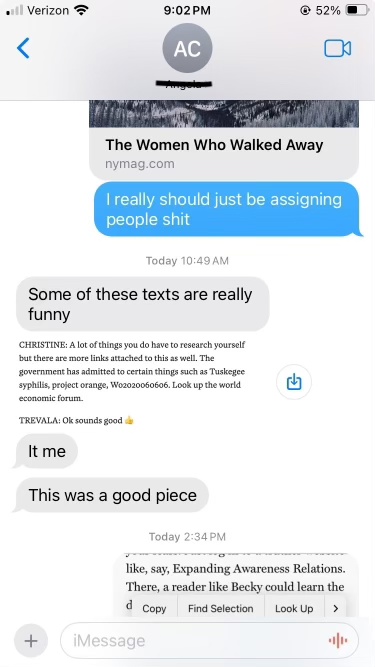
ID: And the text that breaks off is me highlighting a sentence about big Pharma being evil and being like, OK but fair point loony tune
EP: Or the part about how she told people not to take any medication because the government is trying to control us
ID: I MEAN, kinda?!
EP: That is so funny, that’s exactly the text that I was like, ok but she is right?
ID: I do not want to die in a tent off a hiking trail but also I was like, hard relate to this off-the-grid yearning lady
It can be hard if you have a touch of the nut in you, as we both do, to resist the temptation to go full nut
Like it’s just SO CLOSE AND TEMPTING
I kind of hate Bill Gates and sometimes I’m like, just believe it, just believe he’s putting microchips in people
EP: Haha
ID: I mean you already don’t like the guy
Just go the extra mile!
EP: It’s hard as a Jew because you know the natural endpoint of the conspiracy theories are “and the Jews did it”
And yet it is so tempting to follow the thread all the way
ID: Yeah that prevent me from joining the communities
EP: Yes hahahaha exactly
ID: Also a lot of conspiracists are basically stupid
Even if they have some smart ideas
Like you can’t have an intellectual conversation about literature with them
So that’s a bummer
Like at the end of the day, you just want to chill and have a glass of wine and discuss the latest prestige TV
I don’t know that they’ll have good opinions on it
EP: That is such a funny and accurate criticism of conspiracy theorists
ID: Like what do QAnoners do for fun? When they want to kick back and chill? I need some off-time, personally
EP: That is a great question
So friends! Remember this? The early DFW story about a man who pretends to be Jewish, called “Solomon Silverfish”? Well, I found a copy of the literary magazine it was published in (Sonora Review, issue 55, in which it is re-printed as a tribute) on Ebay and bought it for a cool $10 so I could read! And the verdict is…
… it wasn’t good!
I mean, the truth is, I kind of saw this coming. I am actually a fan of what James Wood called “hysterical realism”: I’m a maximalist and I enjoy things that are fast-paced, so Infinite Jest suited me just fine (as did, for what it’s worth, White Teeth). But I think that in order to pull off hysterical realism, every detail needs to be absolutely not one tenth of a centimeter out of place, or else the rapidity of the tone gets thrown off. And so perhaps I’m at a disadvantage reading this piece as a Jew, because it just became so clear, via the details, that David Foster Wallace knows nothing about Jews.
The basic plot is as follows: Solomon Silverfish, a lawyer of indeterminate specialty (sometimes he represents his brother-in-law, prone to drunk driving, and sometimes some unsavory pimp-types) has long been devoted to his wife, Sophie, who is in the end stages of dying from cancer. He’s called out by said brother-in-law in the middle of the night to fetch him from the drunk tank, but when Solomon goes, his friend is there with another acquaintance and Silverfish’s otherbrother-in-law. The trio tells Silverfish they know he isn’t really Jewish and he’s been lying about it all these years; Silverfish essentially says he never told them one way or another, so it doesn’t really count as lying. Meanwhile, Sophie’s parents visit her at her home and tell her what’s happening; Sophie stands by her husband, but in the midst of her defense, gets violently ill and is rushed to the hospital. The piece ends with a section in the first-person (most of the rest is, like Infinite Jest, sections in rotating close-third) voice of the pimp, who’s describing Solomon’s first attempt to buy weed for Sophie, to alleviate her nausea, and then a questionable vision of Silverfish committing adultery (I think it’s a hallucination but what do I know).
At the risk of sounding like a total philistine, I really have no idea what the… point of this story was, overall? There were nods, I think, to the all-consuming power of romance and partnership––Solomon and Sophie’s devotion to one another is total and, at times, sweet––and to the great equalizing indignities of dying, but there seemed to be some kind of Bigger Meaning that was just completely lost on me. I say “seems to be,” because a non-Jew pretending to be a Jew––and maybe I’m biased here but it’s what I think––is an idea very pregnant with symbolism, and it was just completely unclear what it was symbolic of. Literally the only thing I can come up with is that Solomon feigned Jewishness because he was so instantly enamored of Sophie that he decided on the spot to live a lie, and the fact that they remained the Platonic image of love means that Solomon’s choice was the right one in the face of his small-minded identity-obsessed compadres. Translation: love conquers all, love is love, whatever. But this seems way too saccharine and quotidian for a guy who characterized his first novel as “a conversation between Wittgenstein and Derrida,” and who generally is not a sentimentalist nor one whose work betrays any interest whatsoever in community norms and politics.
The other trouble here for me was again, the details. The characters were completely unbelievable Jews. And I recognize that I’m shooting myself in the foot here, because one hallmark of hysterical realism is that the characters are all kind of meant to be figures/symbols/composites of tics/quirks/antics and not really, well, real. And this largely did work for me in IJ, because I did feel that for the most part, there was some heart and authenticity there (it varied though: I felt it more in the halfway house than the tennis academy). Perhaps this is because DFW knows what it feels like to be a tennis phenom, a depressive, an addict, etc.
But he doesn’t have a clue what it means to be a Jew, and it shows. I don’t mean anything as grandiose as carrying galut around in your soul; I mean he literally doesn’t know what words Jews use. For example, when the trio of Silverfish’s familiars are interrogating him about his deception, one of them says something to the effect of, “You sat with us in Temple! You did the mitzvahs! You ate the matzah at our seder! How dare you!” Never mind that this reads like someone looked up “what are Jewish words” and just threw them on the page; the fact that he used the word “Temple” automatically assumes these are Reform Jews, and for Reform Jews, the stance toward intermarriage ranges from “neutral” to “wholly embraced.” There is some nuance there: I don’t know when this story is supposed to take place, so perhaps the kind of light stigma of intermarriage would have been held by Sophie’s family just as a vestige of shtetl mentality, and obviously, the men are also reacting to the deception in addition to just the fact of him being not Jewish, so some of the anger might be more about that. But the truth is I don’t really think that’s why. I think DFW is trying to imply these are Serious Jews by using this kind of vernacular, but doing so without knowledge of what Serious Jews would look like or say––probably not Temple, probably not “annulment” when they talked to Sophie about ending the marriage (they’d like use afka’inhu, the halakhic equivalent, or say that she should force Solomon to give her a gett, or something like that). This is all to leave aside the fact that they speak basically like low level gangsters with the occasional Jewish term thrown in, nor do they do any of the things Serious Jews would do over the course of the story (like, IDK, pray, wrap tefillin, etc.).
I would be really curious to hear another person’s take on this (and no, DFW bros on Reddit being like “This was great as always” doesn’t count as a “take”). I’m sure there is/are practical and/or philosophical reason(s) for specifically using a goy masquerading as a Jew in this story, and I would love to know what they are. There is a chapter in this book that seems to revolve around the thesis that DFW was interested in language as a way of “self-creation” and that “Solomon Silverfish” was an unsuccessful attempt at grappling with that idea in writing, but it’s $110 to get digital access so I’ll just have to assume her qualms with it were the same as mine.
In closing, I’m still glad I spent the $10, and I still love you DFW! But this story was not good.
“The anti-capitalist scholar Joel Kovel has gone as far as saying that the US mental health industry has proliferated and grown exponentially because the diagnoses of individual disorders and their treatments are part of the same social process. Writing before the mindfulness boom, Kovel observed that the mental health industry had been handsomely rewarded because of its institutional role in smoothing over and masking the growing contradictions of advanced capitalist societies. This took place despite the lack of much conclusive evidence for treatments, scientific progress or mastery over mental illness and psychological disorders. As Kovel puts it: ‘A purely psychologic view of human difficulties is a handy way of mystifying social reality, and it requires no feat of imagination to comprehend capitalist society would come to reward the psychiatric profession for promoting a special kind of psychological illusion.’
“… Back on the MBSR [Mindfulness-Based Stress Reduction] course, the next exercise was ‘mindful movement,’ or basic yoga. Being more of a Tai Chi practitioner, I sat this one out until they got to the end, a supine posture on the floor. Relaxing, I couldn’t help but think about how mindfulness interventions have a Puritan obsession with controlling emotions, especially anger that is cloaked in new psychological and neuroscientific garb. The labels for dysfunction change over time––immaturity, hysteria, neurasthenia, nervous breakdowns, lack of emotional intelligence, problems of emotional self-regulation, mindlessness––but the fundamental model stays constant, based on a cult of subjectivity.”
Ronald E. Purser, McMindfulness: How Mindfulness Became the New Capitalist Spirituality
I watched the Sopranos last summer, after a years-long campaign waged by my husband to convince me to get into it. I liked it a lot, but I wouldn’t say I thought about it terribly often, the way I think about some other shows. Fast forward to last month, when I started rewatching it out of lack of anything better to do, and now I am full-on obsessed. I have come up with no fewer than three thesis ideas for someone majoring in media studies based on the show (DM Siobhan for details), incorporated a long rant I tend to go on about whether or not Tony is a true sociopath into a lengthy essay which will likely never see the light of day, and, my shining moment, read the entire oral history of the Sopranos in less than 24 hours. It’s fine, not life-changing, but interesting enough. Below, a really hilarious interaction––that has nothing to do with the show––between Michael Imperioli (who played Christopher) and Steve Schirripa (who played Bobby).
Steve: I would feel so terrible if I went, killed the deer, and I saw it laying there. I would feel terrible, especially for sport. If people do it, and they eat the food, that’s different.
Michael: If you’re starving, maybe.
Steve: It’s survival. Me, personally, it’s not my thing to kill a rabbit. I won’t kill it, it’s not my thing. Fishing is one thing.
Michael: Why is fishing one thing? Fishing is okay?
Steve: Fishing is okay.
Michael: Why?
Steve: People eat the fish.
Michael: Fish don’t have feelings?
Steve: I don’t know if they do.
Michael: Sure they do. Of course they do, what do you mean? They’re alive.
Steve: Fish cry? When they’re swimming, two of them, and a hook comes out, and gets one of them, the other one is crying?
Michael: When you see a fish on the hook, that fish don’t look so happy to be on that fucking hook. They’re struggling with their last breath to get off it and get back in the water. You don’t think they suffer when they’re hanging on the hook?
Steve: I don’t know if they suffer.
Michael: Look at dolphins, what about dolphins? Dolphins are smarter than humans, you know that, right?
Steve: They’re not smarter than me.
Michael: They communicate telepathically and they’re smarter than human beings.
Steve: I don’t think a dolphin is smart. I’ll take an IQ test.
Michael: You know what else is smarter than humans, they say? Squid. Their DNA is unlike anything else on the planet. They think squids might have come from like a meteor from outer space, their frozen genetic material was on a meteor and landed here.
Steve: What are you doing? Are you doing this to fucking drive me crazy? Do you hear yourself? Octopus from outer space, do you hear what you’re saying?
So they’re auctioning off the entire contents of the late Elizabeth Wurtzel’s apartment. Most of it is actually kind of ugly and not cool (she has a weird amount of framed art from CB2?) but for the low, low price of $85 (as of now), you can get her AA sobriety chips! In the words of AC, “This feels cursed.”

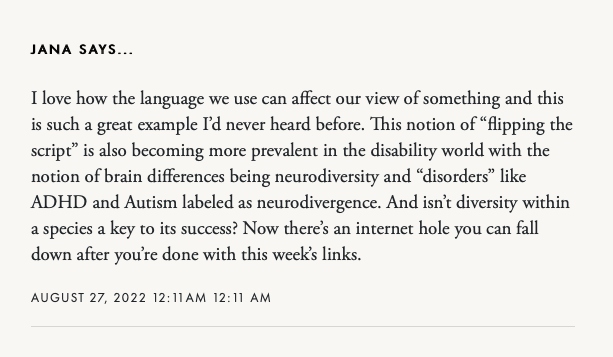
Look––I’m not saying it’s wrong to consider the linguistics here, or to push back against a human-centric worldview, but… do we really have so much time on our hands that we are worried about the language we use around sharks? Are we really concerned that vast swathes of people are developing speciesist views, and that this will have some kind of measurable negative impact? Or that sharks are being actively persecuted because the average person (who interacts with them… not at all?) uses the wrong terminology? In the nicest way possible: log. the hell. off.

 Itinerantdaughter's Blog