There’s some weird noise––probably associated with construction––that goes off outside my window every 2-3 hours during the day, and it sounds like the alarm triggered whenever an idealistic young upstart escapes from a dystopian commune in the future. I should be annoyed when my concentration is broken but instead I just think, “Run, XTC-619! Run toward the Technicolor wheat fields of freedom!”
Archive for the ‘I Hate Writing’ Category
Tweet
May 26, 2016Theresa Duncan, Again
May 19, 2016I’ve written about Theresa Duncan before, in a mini-obit that strikes me now as pretty adolescent (although I’ve resisted editing it.) And today, while writing something real (aka something not to be published here), I remembered an old essay of Duncan’s, perhaps the only piece of her writing I’ve ever really enjoyed or understood, the latter more a comment on her penchant for vagueness masquerading as intellectualism rather than my own powers of comprehension. In fact, I was writing my own essay about the Hotel Chelsea at the time, and about the inability of my own generation to create or connect to anything meaningful (it was a tough time in my life, I guess), but because of this essay I just stopped in my tracks, declaring myself scooped. It’s not quite as impressive as I remember it being last time I read it, but there are some bits that I still really enjoy (“smell like someone else’s teen spirit,” par example, and that line about the ancients drinking at El Q. I used to drink there often; I know those people.)
I left her typos intact. As a parting note: I wonder what’s happening with that Van Sant biopic?
Generation Xorcism: Baby Boomer Ghostbusting at the Chelsea Hotel
“I remember you well in the Chelsea Hotel,
you were talking so brave and so sweet,
giving me head on the unmade bed,
while the limousines wait in the street.”
–Leonard Cohen, Chelsea Hotel #2
The Chelsea Hotel, with its dead poets and rock star revenants, is one of the most counterculturally significant locations in New York City, perhaps the most hipster-haunted location in the U. S. of A. The glamour of the Chelsea, with its curlicue iron balconies, resolute dumpiness and ghostly auditory echoes of a thousand fantastic lays–Edie Sedgwick and Bob Dylan, Leonard Cohen and Janis Joplin (musical homage to said encounter above), unspeakably sexy Vogue model Verushcka and Peter Fonda–is still utterly evident. Even the ugly abstract art in the lobby speaks to the place’s authentic Bohemian status, unlike the gorgeous, expertly crafted products of the boutique-art doppelganger Chelsea four or five blocks West. When I’m in town I like to go to the El Quijote bar downstairs from the hotel and drink next to people who have been perched for hours–perhaps days, even decades, a century?–on the black vinyl barstools. These are drinkers who make my thirstiest night seem like I’m sitting in a high chair in my mama’s kitchen. This is, after all, where Dylan Thomas uttered the last words, “I’ve had eighteen whiskies, I think that’s a record,” before retiring to sleep off his hangover for all eternity.
In 1992, critic Anthony Vidler published a book entitled The Architectural Uncanny, which posited that architectural space is psychically charged [editor’s note: need this book immediately], which echoes an earlier theory of Walter Benjamin’s that fetishism explores a confused overlap between the mental and the physical, the organic and the inorganic, as in the great poster for Andy Warhol’s film about the Chelsea Hotel, above. Having a paella dinner at El Quijote in the October rain this year, I had a chance to mull these theories over vis-a-vis the Chelsea. On the sidewalk outside the hotel, the red brick facade was suddenly a tombstone, its historical-monument plaques epitaphs, the still vibrant swarm of life inside a danse macabre to the tune of somebody else’s youth. The mirror over the bar didn’t reflect back my own face, but someone inhabiting someone else’s possibly better era, like the 19th century photo-double that grins back at Jack Nicholson’s 1980s hotel caretaker in Kubrick’s The Shining.
The uncanny version of the El Quijote mirror gives us a funhouse look down the decades into the irrational possibilities of the bewitched architectural space. Suddenly my generation’s much remarked (and thereby constantly reinforced) “ironic” embrace of other peoples’ clothes and music and styles is not a choice, but a masochistic assignment to worhip and enact scenes from the previous generation’s bygone but admittedly intoxicating youth. The crimson awning over the lobby entrance in this light is the famished cat in the animated cartoon who deceptively rolls out his tongue as a red carpet leading into the flashing entrance marquee of his fanged mouth. Sitting in the Chelsea drunk on the musty but still potent perfumes of Jack Smith and Joey Ramone, I’m actually volunteering to surrender my subjectivity and enage in a seance where I am not a citizen of the 21st century but an empty portal for some East Village other. If you doubt the Chelsea’s status as the Haunted Indian Burial Ground of Baby Boomer hipster culture, consider that no significant counterculture has been produced by Western white middle class youth since Sid Vicious murdered his girlfriend on this very spot and died of a heroin overdose in Rikers prison in the middle of the East River shortly afterward.
Like the Chelsea Hotel, our present culture is so haunted by the long-over and yet uncannily indestructible “youth” of the Baby Boomers, so crammed with grey ghosts that room to inhabit the present is nearly nonexistent. That cultural undertow you’ve been feeling lately is them, invisibly buttonholing young strangers for just one more shared joint or pint, just one more amazingly funny anecdote about what happened back when. Our samizdat, our stray revolutionary pamphleteering, takes place in the invisible world inside the computer. Like peering into a private diorama inside an Easter egg, Generation X and younger generations have to look to the digital to find our stories anywhere. It’s not the already dying years of my own prime that I remember well in the Chelsea Hotel, it’s a mnemonic rock and roll rosary on which I worry the beads of memories that aren’t really mine. There is a vision haunting contemporary culture this Halloween, it looks like a spookhouse and smells like somebody else’s teen spirit. Like that famous adage about a nice place to visit, there’s nothing wrong with a trip to the Chelsea, as long as you leave the getaway limousine idling in the street. Request a 2005 model, and if you overhear a voice saying “Well Andy says…” grab your iPod and run like hell.
A Girl and Her Gameboy
April 10, 2016When I was in maybe tenth grade or so, I read a little interview with Lisa Kudrow in InStyle Magazine (slow Sunday, I guess) in which she said that her absolute favorite stress reliever of all time was Tetris on Gameboy. I knew the sweet bliss of zoning out to Tetris myself. When my brothers and I were little, my mother used to buy us new video games for our handheld devices––back then, we had Gameboys and Sega Nomads––so we would stay relatively quiet during the sixteen-hour-plus car rides our family took every summer. Sonic the Hedgehog was a great favorite, but it was anxiety producing, as you were supposed to be aspiring to new levels. My brother had a Kirby game, which was fun, but a little bad-trippy (somehow I knew even at that age.) Tetris, on the other hand, never seemed to make me worry about my accomplishment; I was always just content to play. So streamlined, so clear and mathematical, that dinky digitized Russian theme song––heaven!
But by the time I read that little interview with Phoebe, Gameboy was a thing of my family’s past. Still, her mention of it stirred a longing in me that remained for the next ten years, until finally, I had thirty-odd bucks and some time to spare, which I spent browsing Ebay for old machines. Now, I am the proud owner of an old-ass Gameboy––the big, gray, clunky kind, not the sleeker color versions of the late nineties. Although the screen has fallen off a few times (thank G-d for superglue) I have only had to change the batteries once in the past two years. The most serious technical glitch I’ve encountered has been solved by blowing in the little slot at the top or rubbing the batteries until the machine goes on. Take that, iPhone! (And yes, I do believe playing it on the Game Boy is somehow more enjoyable than downloading it and playing it on my phone would be.) I play it everywhere: on the plane, on the train, on ferries to exotic islands off the coast of Sicily. Okay, so maybe I mainly play when I’m being transported somewhere, but still, I play a lot. People tend to find it pretty funny, and it makes me happy to see how joyfully nostalgic they get seeing this lovable relic. “Does this make you a hipster?” a lady on the New York City subway once asked, only half in jest. I don’t care! I thought to myself. I love Tetris! And if loving Tetris is wrong, I don’t wanna be right!
Recently I read this article about Rutherford Chang, an artist who is working on an ongoing project to beat the top Tetris score in the world (held by Uli Horner, a London-based architect.) Here are a few things he said about Tetris:
“Every 10 lines you complete, you advance one level and the pieces fall faster,” he says. “Eventually they fall so fast that you can’t keep up and you die. You can’t ever beat the game. It’s about squeezing in as much perfection as possible in this limited time before your inevitable death.”
Whether you read Tetris as a parable for life’s finitude or the savagery of capitalism, there’s no denying the focus it requires. “It’s a pretty brutal game,” says Chang. “It definitely requires a lot of concentration, where you only think about this rudimentary logic. It’s meditative.”
Meditative––that’s why I do it. It’s like my version of mindfulness. And for a split second after reading about Chang, I felt envious of him, sitting around all day playing Tetris and doing it to some legitimate end. But then I realized that if I were doing what he is doing, the game would cease to soothe me the way it does. Once something becomes an ambitious pursuit, it no longer can be relaxing (see also: writing.) And so for now, I remain a dedicated amateur.
A Gig for Me
April 7, 2016Back last year when I was researching a piece on Amish converts, I read Called to Be Amish: My Journey from Head Majorette to the Old Order by Marlene Miller, which is, as the title describes, Miller’s memoir of becoming Amish. She fell in love and eventually married a man who was born Amish but hadn’t, during their courtship and marriage, chosen to join the church (important note: the culturally popular notion of “rumspringa” isn’t always a year. Because Amish aren’t eligible for baptism into the church until maybe fifteen or older––varies somewhat from community to community––a teenager can put off joining the church for years, during which time he or she could feasibly explore the world. Shunning, as a postscript, really only happens when someone has joined the church and then reneged on his/her vows.) After they had their first child, the couple joined the church together.
Anyway, back to Miller: now that I know I don’t need her participation for said piece, I can say without fear that the book isn’t good. I mean, it is good in that the story is interesting and the perspective rare, but the writing isn’t going to get your blood flowing, if you’re into that kind of thing, which I am. I wouldn’t go so far as to say she shouldn’t write because she isn’t a writer (like I would with many celebrities who pen memoirs) but high art, this ain’t.
And yet––there was a moment in her prefatory acknowledgments that made me jealous about my lack of involvement with the text. Here it is:
“I’d like to thank Elsie Kline for typing my first draft. Because I wrote everything longhand, I’m sure she had a very difficult time.”
Now there is a job for me: typing up the memoirs of an Amish convert. Who is this Elsie Kline, and what kind of bribery does she accept?
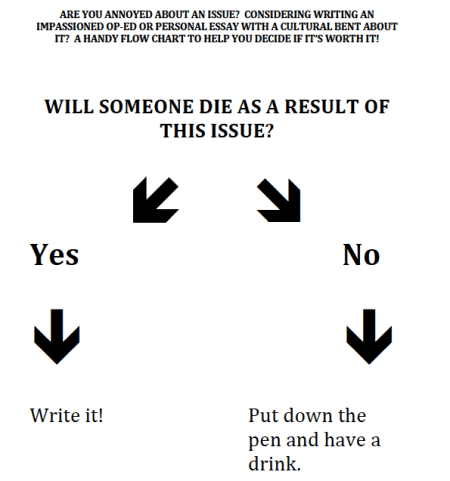
Think Piece Anxiety?
March 24, 2016Are you wondering whether you should write a think-piece? I’ve made a helpful flow chart to help you decide!
Another Game
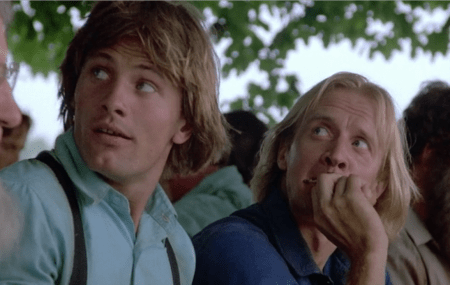
March 8, 2016Spotting pre-fame celebrities as extras. Here’s Viggo Mortensen as an Amish guy in Witness.
Guys, I Give Up
February 3, 2016Re-reading Lolita, and having a much different experience of it than I did upon my first time, at seventeen. What hasn’t changed is how fucking amazing some of the language is. Look at this fucking sentence:
“I believe the poor fierce-eyed child had figured out that with a mere fifty dollars in her purse she might somehow reach Broadway or Hollywood––or the foul kitchen of a diner (Help Wanted) in a dismal ex-prairie state, with the wind blowing, and the stars blinking, and the cars, and the bars, and the barmen, and everything soiled, torn, dead.”
Seriously, I give up.
Essays That I Wrote That No One Will Publish, Part XXXVI
February 2, 2016The title is a bit of a misnomer, actually, because I did basically find a home for this, but then decided it wasn’t really a smart placement, for political reasons (how coy!) But I decided I like some parts of it, so I figured you might too. ENJOY!
***
In the weeks leading up to our move from Brooklyn to London, I told anyone who asked (which was everyone) that I was not nervous one bit about relocating to a foreign country. What was there to be nervous about, I argued. Globalization had ensured that basically all major cities are the same, and in this one, they spoke English, to boot. If anything, it wasn’t going to be different enough, I worried privately. Perhaps we should have lobbied my husband’s company for Hong Kong, or Paris, or Sao Paolo.
But then, the moving debacle happened: about an hour before we were scheduled to move into our new apartment, the broker called us. Our landlady had had to return to Dubai on an emergency, and hadn’t been able to get all of our personal stuff out. Perhaps we could move it to a storage unit and send her the bill? Upon arrival, I surveyed the scene. Her personal stuff was everywhere: mothy wool sweaters packed into closets that we’d been promised would be cleaned out, children’s drawings stacked in cupboards, half-filled bottles of spices lining the shelves in the kitchen, a bucket of dirty water in the bathroom. The landlady herself was unresponsive, and when we expressed our concern to the agents they seemed eager to wash their hands of us, explaining that it wasn’t their job to do x or y (what it was their job to actually do, I have yet to fully understand.) The bottom line, we were told, is that there was nothing we could really do but pay to have her stuff moved out.
I’d dealt with my fair share of shady people throughout my adult life, realtors not least among them, and though the experience was never enjoyable, I had always been able to speak up for myself and then go on about my day. It’s understandable that a dismal start in a new home would throw anyone, but I was surprised by how totally powerless I felt in the situation. This sense of paralysis trickled down to even the most basic tasks, including those I was accustomed to and which I’d executed easily back home. For example, grocery shopping. Where was the nearest grocery store? Did I need to tip the person who packaged my groceries? For that matter, did one tip anyone here? If I bought a bunch of apples and found a human finger inside, could I take it back, or was there some secret British law that protected the apple farmer over the consumer? For that matter: what was an apple, and what was money? Too embarrassed to ask questions that would surely be seen as elementary, I found myself wandering aisles examining bottles of olive oil, wondering to myself if perhaps “olive oil” didn’t mean something completely different in England than it did at home. Because after all, if “I’ll move out my personal stuff” meant “Please watch over the leather handcuffs in my nightstand drawer” here (you read that correctly), then what fresh hell was this, anyway?
The pall began to shadow every aspect of my new life, and I spent increasingly more time aggravated with myself for being so thrown, for taking on this new persona that was so resigned in private and timid in public. I began to wonder whether or not I would have reacted the same way in New York. Would a spat with a landlord there, for example, have rendered me incapable of buying a book, or receiving a package, or finding the closest dry cleaner and actually bringing my clothes there? And that’s when it hit me that I had completely underestimated the sense of vertigo one develops after moving far away from home. I had expected to adapt seamlessly to this place, but I hadn’t given the place credit, or myself leeway for being human and, ergo, struggling with change. Even when your new city seems on the surface to be practically identical to your old one––a sprawling urban center with subways and Starbucks and beer-drinking yuppies––there are these tiny discrepancies, sometimes virtually unnoticeable, that can make you feel like you’re no longer the master of your domain, and not in the Seinfeld-ian sense (no one gets Seinfeld references in London, to add to the opportunities for miscommunication.) Your foundational knowledge begins to feel sieved, and your confidence can crumble as a result. And without a network of trusted resources, both human and bureaucratic, to help you navigate the new landscape, it’s easy to start to feel like you just can’t do anything, and couldn’t recruit any allies even if you wanted to, your cultural and linguistic fluency so desperately lacking. I remembered an essay I read some years ago by Olivia Laing, a Brit out of place in New York, on the way the socially adrift tend to become “less adept… at navigating social currents.” Upon re-reading, I nodded to no one.
I wish I could say that the epiphany renewed my tenacity in an instant, but I’m thinking that’s something that’s built up over time, with every bottle of olive oil purchased. But for the record, olive oil means the same thing basically everywhere, and leather handcuffs are never your responsibility.
Distraction
January 20, 2016I have a few big pieces I have to really stay focused on, which means I can’t write smaller things––except for that piece about learning to walk a tight-wire I’m trying to finish but nobody seems to want to publish, which is nuts––but if I did have time, I would write about this chick Rebecca, who vlogs about her trichotillomania.* This video, which shows her shaving her head, went mini-viral a few weeks back.
One thing that’s been gnawing at me since I fell into Rebecca’s TrichJournal clickhole is: if one’s emotional state while pulling is anxious––i.e. the impulse is, like for many OCD and self-harm sufferers, to relieve indiscriminate anxiety via a concrete action/visceral sensation––then post-shaving, does the anxiety remain, or dissipate? I see in the comments that the urge to pull is transferred to other hair––eyelashes, pubic, etc.––although that might be only for some sufferers. If the anxiety remains, then generally, is treatment geared toward anxiety sufferers (medication, meditation, CBT, that kind of stuff) the standard option for those with trich? Is it shown to be effective? I guess what I’m trying to understand here is if trich resembles in its pathology a generalized anxiety disorder that becomes, through reinforcement, focused on cilium, or if the neurological origin of the obsession is more enigmatic, i.e. a fetish or Morgellons Disease? (“Disease.” I have no dog in that fight, just acknowledging that there are many beliefs about it.)
*Yes, I do realize how often I talk about how I don’t have time for small pieces anymore because I’m working on big pieces, and yet how rarely my whining seems to correspond with actual working-on-big-pieces.
Manic Monday
January 11, 2016One time, a friend of mine told me he liked my blog because it was a throwback to those days when people just “wrote about anything they felt like” on their sites. I guess now it’s all too polished (aka written for an audience of people other than said blogger’s father, husband, and lone friend who likes ad lib) and curated and sponsored. Well, no one sponsors me, so I guess I can just say what I like! Which is helpful on this particular Monday, because I haven’t been unproductive exactly, but I just can’t seem to concentrate on anything for more than twenty seconds at a time. Below are the subjects I find myself flitting between:
- I’m way late to this game, but damn, Petite Meller is one weird child-woman. It makes me uncomfortable to watch her pale ass writhing around in a pastel onesie, and yet I have had this video on in the background basically all morning. I think these Kenyan schoolgirls might be my newest fashion obsession. I’ve considered Googling “African private school straw hats” a few times in the past hour, but I’m worried Google would just shoot back, “You’re a fucking racist.” And it would be justified in doing so.
 Also, when I finally get around to creating my hat label, Whimsical Haberdashery, Petite Meller will definitely model my first season. Last note on her: she’s apparently obsessed with Freud, and The Guardian just ran a long piece on the return psychoanalysis, which I recommend although I’m too lazy to link to it. Bottom line: Way to go, Freud! You may be dead but you’re still killing it!
 - I keep meaning to tell someone this because I think it’s hysterical, but the other night I had a dream that the only “serious” critic (whatever that means) to give my book a mediocre review and I drove on ATVs to the Grand Canyon for a little day trip. It was really fun, actually. I think we should consider doing it in real life.
- I’m pursuing a number of very different stories at the moment, and ergo am trying to find a bunch of new sources and have no idea how to go about getting them, aside from this: if you happen to have a son at the Westminster Abbey Choir School, or are a Hare Krishna convert who wears a traditional robe most of the time, or you’re currently in drug rehab and considering becoming a Christian, or maybe you wear the same thing to work every day a la Matilda Kahl, shoot me a note.
- I’m lying to you and to myself here––I haven’t been thinking about any of the above. I’ve just been looking at pictures of Petite Meller. WHY. I get the whole shtick, right now, immediately. I don’t need to hear her breathy whispers about her philosophy degree or her one-woman campaign to help us all bring our libidinal subconsciouses (subconsciousnesses?) to light––I see where this is all headed, which makes me hate it. So why am I lusting after her fake-rosacea? Lord, grant me the strength to resist her (but not yet.)

Oh and PS, she totally stole this hat idea from me. Ask my husband. He knows.
 Itinerantdaughter's Blog