Grace Kelly’s Daddy Issues

March 24, 2014

Grace’s rough-hewn father, John B. Kelly Sr., was already well on his way to parlaying a $7,000 stake into a multimillion-dollar masonry empire when he married a photographer’s model, Margaret Majer. It was “Ma” Kelly who established a set of rules that Grace would live by: “Be just, be punctual, buy only what you need and pay cash.”

Seemingly aloof and withdrawn, Grace grew up under the shadow of achievement (though John B. Kelly’s financial success—he built Philly’s Packard Building—could not buy him Main Line social acceptance). Grace’s father was a superb athlete who had given up boxing to take up rowing and in 1920 won the Olympic single sculls championship at Antwerp. When he wasn’t allowed to compete in England’s prestigious Diamond Sculls at Henley because he “worked with his hands,” he found an avenger: his own son. Kell vindicated his father by becoming a championship rower himself, winning not only the Diamond Sculls but almost every other single sculls championship in the world.

Friends now say John B.’s single-minded determination was not always healthy. “John expected a great deal from his kids,” says Gam. (Years later, his son Kell’s self-confessed philandering helped shatter his first marriage and caused the mother of his six children to remarry and leave Philadelphia. In 1975 Kell’s well-publicized fling with a striking transsexual named Rachel Harlow—formerly Richard Finocchio—was a factor in his decision to drop out of the mayoral contest in Philadelphia when the opposition threatened to campaign with the slogan “Do you want Rachel Harlow as First Lady of Philadelphia?”)

Grace had her own problems with her demanding father(who died in 1960). She did play hockey and swim, if only to please her dad, but with some trepidation. “Poor Grace was something of an outsider at home,” said a friend. “John wasn’t interested in anyone unathletic. He had no appreciation of culture.” From the beginning Grace preferred solitude. She wore heavy-rimmed glasses to read, danced barefoot with her tomboy older sister Peggy (who often went without stockings or shoes) and would daydream about becoming a dancer, an actress, a nurse or an FBI agent. “Grace wasn’t shy like you read everywhere,” insists Peggy, Daddy’s favorite, “she was just quiet.” Still, Lizanne recalls the day “I hid Grace in the closet—and nobody missed her.”

(From People Magazine’s Tribute Piece)

Grace dancing with John

Grace dancing with John

Oh Jesus

March 21, 2014

I had grand plans to write something here––a Q&A Fran Lebowitz style, a dissection of a recent funny encounter I had with a child actress, a poem by Elise Cowen (come to think of it, I should have gone that route)––BUT I just spoke to high schoolers for THREE HOURS about my book, life, etc., and I’m totally wiped.  All I want right now is meat and a nap.  So, with that in mind, the coolest thing I’ve seen in ages:

Meat?

Meat?

THINGS I WISH I HAD WRITTEN

March 13, 2014

The other night at dinner, my dad mentioned Chris McCandless, the wanderer whose death in the Alaskan woods was the subject of the terrifying book Into the Wild.  For reasons unknown to me––not particularly interested in the outdoors, nor the youthful idealism that comes from reading too much Kerouac––the book gripped me from the first sentence, and haunts me though I’m not at all at risk for succumbing to the same misanthropy that McCandless did.  In any case, my dad told me that that every year, numerous people die trying to hike the same trail McCandless did, and there is a subculture of people devoted to the deceased’s specific brand of sustainability.  Of course I thought, “What a great idea for a story!”  But of course, it’s been covered––quite well, in fact, by a writer for Outside.

“[Claire] Ackermann, who was from Switzerland, and [her boyfriend Etienne] Gros, a Frenchman, had been hiking the Stampede Trail, a route made famous by Christopher McCandless, who walked it in April 1992. Many people now know about McCandless and how the 24-year-old idealist bailed out of his middle-class suburban life, donated his $24,000 in savings to charity, and embarked on a two-year hitchhiking odyssey that led him to Alaska and the deserted Fairbanks City Transit bus number 142, which still sits, busted and rusting, 20 miles down the Stampede Trail. For 67 days, he ate mostly squirrel, ptarmigan, and porcupine, then he shaved his beard, packed his bag, and started walking back toward the highway. But a raging Teklanika prevented him from crossing, so he returned to the bus and hunkered down. More than a month later, a moose hunter found McCandless’s decomposed body in a sleeping bag inside the bus, where he had starved to death.

“This tragic story was told by Jon Krakauer in the January 1993 issue of Outside and later in his bestselling 1997 book, Into the Wild. The book, and a 2007 film directed by Sean Penn, helped elevate the McCandless saga to the status of modern myth. And that, in turn, has given rise to a unique and curious phenomenon in Alaska: McCandless pilgrims, inspired by his story, who are determined to see the bus for themselves. Each year, scores of trekkers journey down the Stampede Trail to visit it. They camp at the bus for days, sometimes weeks, write essays in the various logbooks stowed inside, and ponder the impact that McCandless’s antimaterialist ethic, free-spirited travels, and time in the Alaskan wild has had on how they perceive the world.”

Welp.  There goes that idea.

A Tweet

March 11, 2014

You know you’re getting older when you no longer want cocaine to go clubbing, but rather to have the energy to clean your house after a long work day.

Spirit of the Bard, Help Me

March 8, 2014

“What the really great artists do is they’re entirely themselves. They’re entirely themselves, they’ve got their own vision, they have their own way of fracturing reality, and if it’s authentic and true, you will feel it in your nerve endings.”

Pickle

March 6, 2014

ID: I pitched an essay connecting alcohol abuse, David Foster Wallace and True Detective.  The second it was accepted I began to SEVERELY REGRET SUGGESTING IT.  

GS: HAHAHAHHA

My Coworker’s Throwback Thursday

March 4, 2014
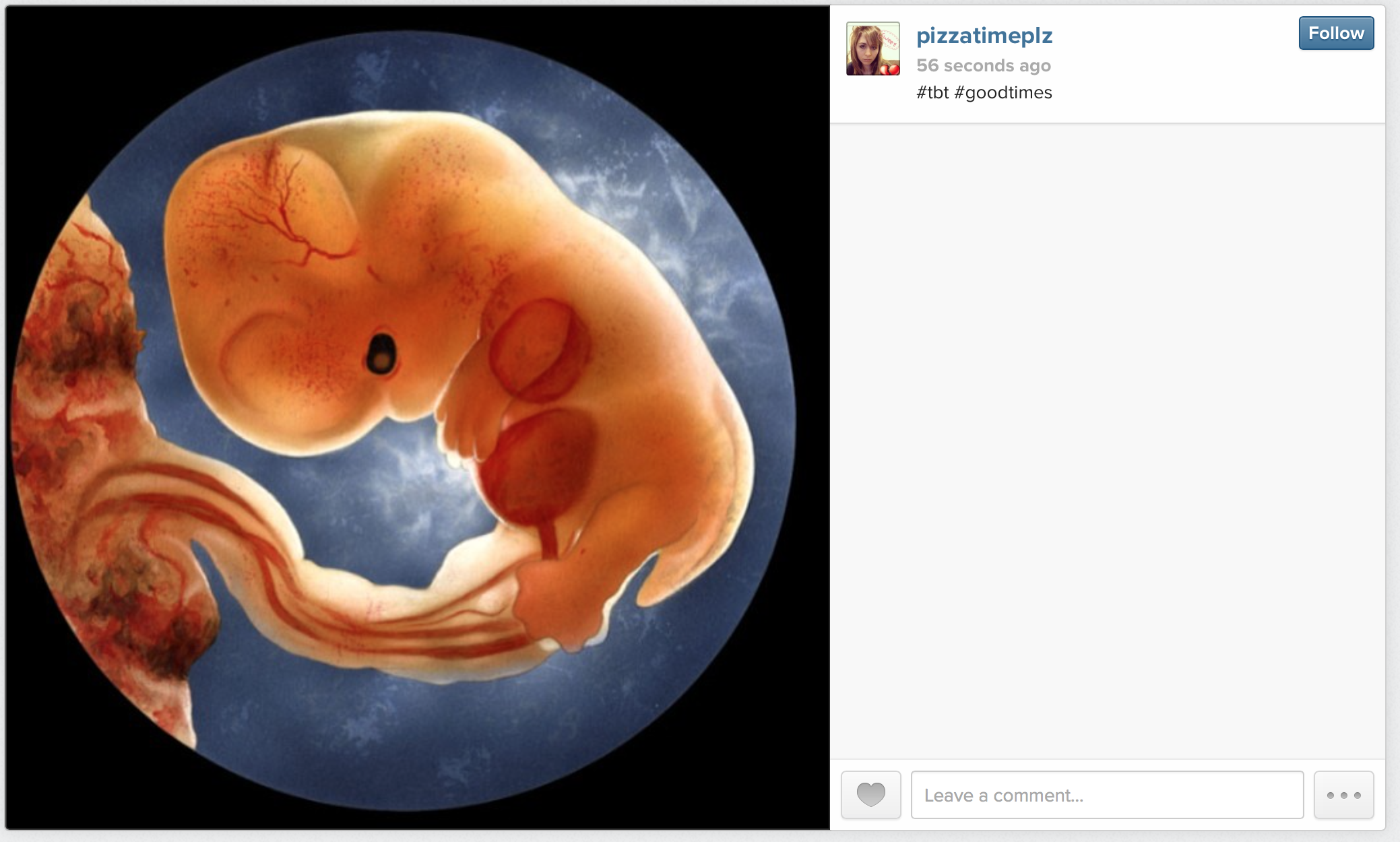
Way, way back.

Way, way back.

True Detective Mania

March 4, 2014

From Gothamist’s montage of visual clues:

Books in Rust Cohle's storage unit.

Books in Rust Cohle’s storage unit.

It would appear that Cohle is interested in the work of one of my favorite poets, Theodore Roethke.  As nothing in this show is not connected, I’ve taken the liberty of listing a few possible reasons why his collection is included (as opposed to, say, Whitman’s.)  None of these feels like THE answer, though, so if you come up with others, please do send along!  I’ll be happy to give you credit in my book-in-progress, The Complete Annotated True Detective.

1. Roethke’s breakthrough book was called The Lost Son.  A reference to Errol Childress?

2. From perhaps his most famous poem, “My Papa’s Waltz”:

You beat time on my head
With a palm caked hard by dirt

Perhaps a reference to the abuse Errol Childress’ father inflicted on him?

3. The similar eeriness of Roethke’s “Elegy for Jane”:

A wren, happy, tail into the wind,
Her song trembling the twigs and small branches.
The shade sang with her;
The leaves, their whispers turned to kissing,
And the mould sang in the bleached valleys under the rose.

… and the lyrics of The Handsome Family’s “Far From Any Road” (the theme song):

From the dusty May sun
Her looming shadow grows
Hidden in the branches of the poison creosote
She twines her spines up slowly
Towards the boiling sun
And when I touched her skin
My fingers ran with blood

4. Roethke’s major themes: the wildness of nature, and the perils of introspection

5. His obsessive work ethic resembles Cohle’s.  From the Poetry Foundation:

Along with these influences, the source of much of Roethke’s poetry was the notes he dutifully kept throughout his life. A measure of the devotion given to his craft can be found in his statement “I’m always working,” and indeed his pockets were seemingly always filled with jottings of striking thoughts and conversations. His less spontaneous reflections found a place in the workbench of his poetry—his notebooks.

6. Of Christ and crucifixion imagery, Roethke was quite familiar.  During one of his many nervous breakdowns, he “entered the first class of the 1957-58 University of Washington school year by flinging ‘himself against the blackboard in a kind of crucified pose, muttering incoherently.’

7. Uh, this:

Epidermal Macabre

Indelicate is he who loathes
The aspect of his fleshy clothes, —
The flying fabric stitched on bone,
The vesture of the skeleton,
The garment neither fur nor hair,
The cloak of evil and despair,
The veil long violated by
Caresses of the hand and eye.
Yet such is my unseemliness:
I hate my epidermal dress,
The savage blood’s obscenity,
The rags of my anatomy,
And willingly would I dispense
With false accouterments of sense,
To sleep immodestly, a most
Incarnadine and carnal ghost.

8. And finally, everyone’s favorite color (check out that last line––oo, wee!):

From “The Far Field”

The slightly trembling water
Dropping a fine yellow silt where the sun stays;
And the crabs bask near the edge,
The weedy edge, alive with small snakes and bloodsuckers, —
I have come to a still, but not a deep center,
A point outside the glittering current;
My eyes stare at the bottom of a river,
At the irregular stones, iridescent sandgrains,
My mind moves in more than one place,
In a country half-land, half-water.

An Open Letter to the Academy of Motion Picture Arts and Sciences

March 4, 2014

Dear “Academy,”

Let me begin by saying that you are one of my most favorite academic institutions, and I’ve been a big fan of the Oscars for as long as I can remember.  As a child, I used the commercial breaks to practice my Best Actress speech in the bathroom; as a teenager, I merrily critiqued the designer gowns of each female attendee, and threw popcorn at the TV when anyone claimed to be happy “just to have been nominated.”  I’ve actually written extensively about my zealous love of the Oscars elsewhere (I cannot link to it without revealing my true identity) so I won’t babble on about this topic; suffice it to say I, and many others, wait for the Oscars with as much anticipation as people who identify as hetero-normative male basketball fans wait for March Madness.

Small bone to pick with you, though, and it rests in the Best Picture category.  Once upon a time, in an idyllic, resplendent era, there were five nominees for Best Picture.  Then, all of a sudden, some years ago, you decided to bloat the category and grant a total of nine nominations.  (I cannot bear to Google to check what year this was implemented in, so wary am I to relive that terrible time.)  Why?  I and others asked ourselves.  Five is a great number: small enough to be easily conceived of, yet large enough for a person to feel like there’s a real competition there.  Nine, on the other hand, is simply absurd.  No one, in this age of Hulu and $17 movie tickets, is likely to see that many films in a season, or even to remember the full docket of nominees come Oscar night.  The field is too crowded, and thus the battle between movies is suddenly less riveting; it’s less a boxing match and more a fight between many rodents.  (There has to be some analogy to economics here––something about market saturation?––but I think you can get the idea without me overdoing it.)  This is all not to mention that everyone’s favorite complaint about the Oscars is that they are way too long.  Did you not see that by adding nominees to a category, you ran the risk of lengthening, rather than tightening and shortening, the ceremony?

But of course, the reason you made this decision is because you believed it would end in bigger profits for––wait for it––YOU.  Believing that we idiot chattel would see “Best Picture Nominee!” and sign over the deeds to our houses, you figured you would sacrifice the air of fierce competition for a bland pretend-tournament in hopes that more people, in more places, would see more movies.  (Of course, you could try to tell me that it’s about giving recognition to as many cinematic masterpieces as possible, but I’d argue that you cheapen your “recognition” by diluting the category with movies that obviously will not win.  Case in point: Philomena, which was I’m sure moving, but never stood a chance.)  But in light of the fact that none of the nominated pictures saw a rise in profit post-announcement, or other awkwardness like this, perhaps you’ll consider changing it back to the old format.

Ever yours,

ID

My Favorite Scent

February 25, 2014
Smells like gasoline and disapproval.

Smells like gasoline and disapproval.

Sushi.  Phone conference with former head of the FDA.  Tonya Harding documentary.  This girl is doing pretty damn well.