LB: i got on the scale today and it read “low”
i was hoping it was referring to my weight but it was referring to the battery.
me: BAHAHAHAHAHA
LB: also my aunt ran over her dog for the second time.
me: omg
LB: she’s such a flake.
LB: i got on the scale today and it read “low”
i was hoping it was referring to my weight but it was referring to the battery.
me: BAHAHAHAHAHA
LB: also my aunt ran over her dog for the second time.
me: omg
LB: she’s such a flake.
It’s really frustrating that the word “dope” can refer to both marijuana and heroin. I mean, it’s too ingrained now to stop, but I thought I’d whine about it for a second. I don’t know about you guys, but it causes me a lot of problems in my own life.
On the next episode of “Word Problems”: the new favorite GLBT, “them.”
I finally found a place to watch the full-length Poto and Cabengo online. And in it, I found new fashion inspiration.

Poto, Cabengo and Granny
Remember the post-movie-book? Do those exist anymore? Man, those were funny.
Werner Herzog’s Grizzly Man
Triumph of the Will
Deliverance
Snakes on a Plane
This Is Spinal Tap
Lars Von Trier’s Antichrist
Alejandro Jodorowsky’s The Holy Mountain
Salvador Dali’s Un Chien Andalou
The Who’s Tommy (or The Wall, for that matter)
David Lynch’s Lost Highway
Peggy and Fred in Hell
Todd Haynes’ I’m Not There
Gummo
Fantasia
The Baby
Kids
Boxing Helena
Poto and Cabengo
I could go on.
For a long time, I lost this reference, and so now I am holding it here so that I can always find it when I need it.
“Indeed, the disciples of Rabbi Nachman of Breslov used to set aside an hour a day known as the Dead Hour, in which all business would cease and nothing structured was permitted, allowing the repressed soul to come to the fore and be free.”
I… cannot… get over… the insane awkwardness and utter witlessness of the show’s host/perhaps the age as a whole? Jesus, if people put me on TV and then listed my many indiscretions and then brought out my caseworker from one or another psych ward, I would probably lash out with something along the lines of, “If this cruel parade is emblematic of the type of world we live in, I’d rather be nuts!” The look of horror on her face when the host announces that they’ve wired 125 producers to ask them to consider her for an upcoming romantic role is just soul-shattering.
So I had to tell Joyce Wadler, who wrote the genius NY Times article that started the whole thing, and here is her response:
ID,
What a great idea!! So often people who are dead to us are long gone before we have the pleasure of telling them. These cards would take care of that. Hope you sell a million. And congratulations on getting the go ahead from The New Yorker, a magazine I could not do without.
Joyce
My brother IS sent me the most hilarious article in the Times the other day entitled “Unfriending Someone, Before Facebook.” Below is an excerpt:
Nor were your choices in those days only friend or unfriend. There were levels of unfriending culminating in that magnificent big gun, “dead to me,” a phrase my family wrapped their mouths around with a relish other people saved for steak.
Dead to me was not achieved with a cowardly little click on the keyboard under cover of night. Dead to me took nerve, it took strength. It also wasn’t for children. You had to be an adult with a house and a job. You cleared a space in the conversation when a certain name came up – let’s use Marvin; waited three beats to make sure you had the attention of the house, and then, and only then, did you say, “He is dead to me.”
I have no choice here but to return to the master of the form, my mother. There came a time when she and her younger brother came to a fork in the road regarding religion, hers being our ancestral one, which eschews pork and enables us to write television comedy, my uncle’s newly adopted religion involving ringing doorbells and giving people pamphlets on Sundays. As he had moved to Los Angeles, this switch might have gone unnoticed but regrettably, one of his converts, returning home after visiting, was 13-year-old me.
My mother’s screams on the phone after she made this discovery are still remembered in Greene County. It remains one of the most powerful denunciations I have heard in my life.
“Aaron,” my mother said, “I never want to hear another word from you. You are dead to me.”
He remained dead to my mother for the rest of life, about 40 years, and from what I could see, she took great satisfaction from it. This was another reason unfriending someone before Facebook was so much better. You didn’t dispatch someone once and move on; you had a lifetime of satisfying moments in which you could unfriend them over and over again.
“So, Milli, what do you hear from your brother Aaron?”
“Dead to me.”
“Your brother still married to that nice woman?”
“Dead to me.”
“I was going out to L.A. and I thought maybe I would look up Aaron, you know we were in the Army together –”
“Dead to me.”
—
I enjoyed it so heartily that I began to imagine what weird, profile-less hermits like IS and I could do in lieu of “unfriending” and my mind turned to a company called Set Editions, which makes the beloved “Stop Talking” business cards, among other funny things.
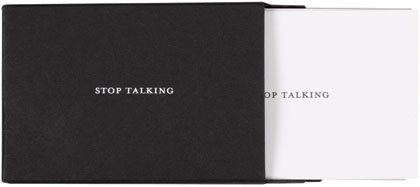
I hand out at least once a day.
So I’ve written to Set Editions to ask them to consider making a DEAD TO ME card. Here is my email pitch:
To Whomever Receives This Email:
I’m an enormous fan of your merchandise –– at the moment, I’m coveting just about everything on the site –– and a proud owner of the “Stop Talking” cards, which it seems are quite popular. I have a small idea for you based on the below article, which is hilarious and short and should go down easy:
(I put the link here but I’m not going to do it again because that just seems excessive.)
I think it would be great to create a little card that says “YOU ARE DEAD TO ME” or, more succinctly, “DEAD TO ME.” There also could be something in the idea of unfriending –– i.e. THIS IS ME UNFRIENDING YOU –– but I myself am partial to the “dead to me.”
Anyway, if this idea appeals to you at all, what I’d ask for in return is just one set of cards!
Again, big props. You guys are hilarious.
Best,
Itinerant Daughter
—
Oh my, oh my, I DO hope they like the idea!
UPDATE: They did! The woman behind Set Editions wrote me the below:
ID,
Thank you so much for taking the time to write with your idea. I get to hear many ideas in the course of doing business, most of which are categorically not hilarious, but “Dead to me” is right up my alley. I will work on it and I promise to let you know if it comes to pass. I suspect it might. You’ll be the first to effectively kill off your friends if it does.
Thanks again. Set Editions is really just me at the end if the day and it still gives me huge pleasure that other people even notice.
Best,
AR
Yay! I’m off now to inform Joyce Wadler of the Times. While you’re waiting for these cards to come out, everybody support Set Editions and buy me these good grief glasses!

Get it?
If you happen to be bored, read reviews of books whose authors were publicly shamed or identified as frauds after the review was written. Par example:
Sarah: A Novel by J. T. Leroy
Scary, sad, and way, way out there, Leroys [sic] picaresque debut novel follows a young boy through southern truckstops, where lot lizards turn tricks for drivers whose tastes run from women to transvestites to boys in jeans. Sarah is actually the name of our heros mother, and in the beginning they both work for Glad [sic], a fairly nice pimp who treats his whores decently and serves them up to a not-too-rough clientele. But when the boy appropriates his mothers name and gender (at least in appearance) to go wandering, he winds up in the clutches of a really bad guy named Le Loup. The gory details of how Sarah is abused by this monster and his cohorts will come as no surprise to those familiar with Leroys journalistic pieces (in Spin, Nerve, New York Press) under the pseudonym Terminator, some of which dealt with his own experiences. Its [sic] disturbing to encounter a 20-year-old who knows this much about lifes [ed note: why isn’t this reviewer familiar with the possessive?] seamy side, but Leroy depicts his damaged, degraded characters with considerable tenderness. Not exactly a laugh riot, but not as unrelievedly sordid as a plot synopsis might suggest. –– From Kirkus Reviews
The funniest part of this review is of course that the writer wasn’t 20 and knew shit about life’s seamy side!
And about A Million Little Pieces, pre-scandal:
Frey is pretender to the throne of the aggressive, digressive, cocky Kings David: Eggers and Foster Wallace. Pre-pub comparisons to those writers spring not from Frey’s writing but from his attitude: as a recent advance profile put it, the 33-year-old former drug dealer and screenwriter “wants to be the greatest literary writer of his generation.” While the Davids have their faults, their work is unquestionably literary. Frey’s work is more mirrored surface than depth, but this superficiality has its attractions. With a combination of upper-middle-class entitlement, street credibility garnered by astronomical drug intake and PowerPoint-like sentence fragments and clipped dialogue, Frey proffers a book that is deeply flawed, too long, a trial of even the most na‹ve reader’s credulousness-yet its posturings hit a nerve. This is not a new story: boy from a nice, if a little chilly, family gets into trouble early with alcohol and drugs and stays there. Pieces begins as Frey arrives at Hazelden, which claims to be the most successful treatment center in the world, though its success rate is a mere 17%. There are flashbacks to the binges that led to rehab and digressions into the history of other patients: a mobster, a boxer, a former college administrator, and Lilly, his forbidden love interest, a classic fallen princess, former prostitute and crack addict. What sets Pieces apart from other memoirs about 12-stepping is Frey’s resistance to the concept of a higher power. The book is sure to draw criticism from the recovery community, which is, in a sense, Frey’s great gimmick. He is someone whose problems seem to stem from being uncomfortable with authority, and who resists it to the end, surviving despite the odds against him. The prose is repetitive to the point of being exasperating, but the story, with its forays into the consciousness of an addict, is correspondingly difficult to put down. — from Publishers’ Weekly
This review isn’t as funny to read if only because it says the book is bad, and therefore still holds water now, but I like it because it makes fun of Frey for being a total dick, which he is.
And finally, Love and Consequences, written by a mixed-race foster child from the ghetto who turned out to actually be way white private-school educated Margaret Seltzer.
Jones was only five years old when she was taken away from her family after a teacher noticed signs of sexual abuse. After being bounced around from house to house for three years, Jones’ caseworker takes her to South Central Los Angeles and the home of Big Mom, a tough, religious African American woman caring for her four grandchildren. Here, Jones finally finds a home and a family and quickly learns the rules of the neighborhood, which is run by the Bloods. Her two older brothers, Tyrell and Taye, join the gang, and Jones longs to as well, even after both brothers go to jail for different offenses. In spite of terrible losses—Jones calls a friend she saw just the night before and learns that he has been murdered—Jones becomes a provider for her family by running drugs. Eventually, she surprises even herself by doing what she once thought was impossible: getting into college and leaving South Central. Raw and powerful, Jones’ memoir is unforgettable, painting a vivid picture of a world most of us turn away from, one that thrives on loyalty and love amid all the bloodshed. — a Booklist Starred Review
There are many other books you can do this with (An Angel at the Fence, or Forbidden Love, and the list sadly goes on) and it’s a great activity for an afternoon when you’re feeling perhaps like you’ve done something really wrong. “Well, at least I didn’t write a memoir about walking across Europe looking for my parents during the Third Reich and then being adopted by a pack of wolves even though I grew up in Schenectady!”

I would given Lagerfeld even more credit if somehow the bag portion detached into a (somewhat misshapen) clutch and you could use it as an ACTUAL HULA-HOOP!
 Itinerantdaughter's Blog