Archive for the ‘Conspiracy Theories’ Category

WHY IS NOBODY TALKING ABOUT AL SHARPTON?

November 8, 2012

Okay, so I’ve just seen that Al Sharpton credits his weight loss to “vegetarianism,” but seriously, did anyone else not watch the election coverage and worry that Al had developed a wee amphetamine habit?

This ain’t just broccoli.

I’m very worried about the Reverend.  Who will keep it real if he kicks the bucket?  Who will tempt us with threats to run for President?  Who will make surprise appearances on Law and Order: Special Victims Unit and Saturday Night Live?  Ain’t nobody to replace the Rev!

Once Again…

November 6, 2012

Check out what’s happening at BAM Cinematek this week:

Hello movie lovers!

This weekend, BAMcinématek’s Puppets on Film series returns by popular demand. One of the best attended programs of last year, this interactive, family-friendly series will feature live performances and workshops for children, a confetti-filled Labyrinth sing-along, Oscar-winning favorites like Babe and Jurassic Park, and unsung gems like the visually stunning Strings.

The week kicks off, though, with our week-long run of Quadrophenia (in a pristine 35mm print!), a classic portrait of British mod culture featuring music from The Who’s epic double album.

We hope to see you here!
—The BAMcinématek Team

Nobody panic.  I’ve already contacted BAM about next year doing A Muppet Christmas Carol.

FOILED Part a Million

November 2, 2012

I pitched recently a story to an editor of mine about the Haredi Jewish desire to eradicate technology, specifically the Internet and smart phones. Here is my pitch, briefly:

You’ll know, of course, about the battle the Hasidic world is waging against the Internet.  In late May, more than 50,000 Hasids attended the first Anti-Internet asifa at Citi-Field, and similar smaller events were held in London, Zurich, Vienna, and Antwerp in the first week or so of September.  (This, of course, is in addition to the myriad smaller ways various rebbes/rabbis urge followers to abstain from Internet use or, at the least, use filtering software.)  Most of the analysis up until now has been “Of course, religion hates free speech!”  But I’d like to use the 100-page-plus booklet handed out at the first asifa –– which I’ve read twice –– and other sources regarding the secular culture’s attitude toward the Internet to compose a piece directed at the issue from another angle, namely, “Why We Should Approach the Internet Like Hasids.”

And my editor’s response:

I think, honestly, this doesn’t quite work for us either. Thing is, we’re very conscious of engaging with discussions that are taking place at any given time, so this is an idea that may have worked well in the days leading up to, or just after the large Hasidic gathering. But for now it doesn’t seem pegged to anything on people’s minds.

And yet AND YET… today, in Tablet, an article by Liel Leibovitz who I love perhaps to an extent that is sort of creepy, entitled “iPhones Are Bad for You: What the ultra-Orthodox campaign against smart phones as a ‘spiritual Holocaust’ gets right about technology.”  (Full article here.)

Excerpt:

“The rabbis, then, have it right. Their reasons for banning smart phones may be different—they are primarily concerned that device owners will use them to access corrupting content like pornography—but their hearts are in the right place. We may not want to follow their advice and banish our iPhones altogether, but we should heed their warning and realize that our new shiny forms of connectedness come at a steep spiritual cost.”

He basically took my thesis!  Instead of being annoyed that he did this, though, I’ve decided that I’ll be happy that Liel and I are on the same wavelength.  (If he were here right now, I’d point my fingers at my eyes, and then silently at his, as if to say, “I’m watching you, LL.”)

PS I’m confused because I’ve always pictured him as a little old man, and yet…

Neither old nor particularly little?

New York Magazine Article “Is Everyone on the Autism Spectrum?”

October 29, 2012

Summarized: Yes.

Find here.

Okay Now You’re Just Blatantly Stealing

October 24, 2012

skinny house!

So when I heard that a Polish architect had volunteered to build a really skinny house in an alleyway for Israeli writer Etgar Keret, I of course immediately jumped on that shit.  Below is an email I sent to his publicist over a year ago:

Dear AD,

Apologies if you’re the wrong person to reach out to about this (I also emailed Ofer Ziv.)  I’m a freelance writer and editor based in Brooklyn, New York, and a longtime fan of Etgar Keret’s work.  A colleague sent me a link to this story about the “Keret House” that is being constructed in Warsaw.

I’m wondering if, first of all, Mr. Keret is still planning to participate in the project (is he going to live in this slip of a thing?!) and also if he does still want to invite writers and creators into the space when he occupies it.  I think it would make a fantastic story,kind of a no-brainer On Location piece in Home and Gardens section of the Times, though maybe there are already scribes lined up to cover it.

Your response is greatly appreciated!  Hope you are well and having a lovely week.

And lo and behold, what is the “On Location” article this week in the Times?  You guessed it.

Riddle Me This

October 23, 2012

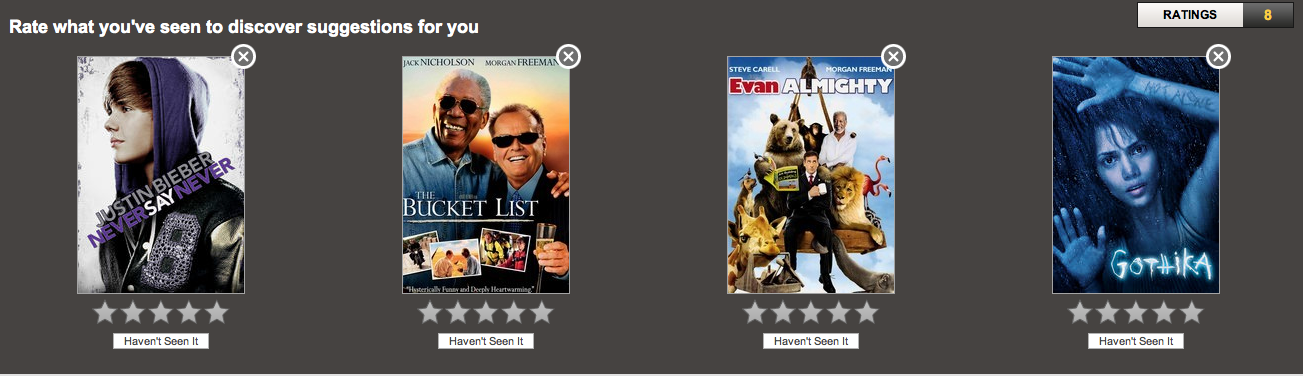
Why, if Netflix knows what I’ve recently watched, what categories of movies I may like (“gritty”) and also where I left off in the most recent TV show I had playing, do they continuously ask me to do things like rate Justin Bieber’s Never Say Never?

I just don’t understand this little box Netflix always displays on its homepage.  What’s the marketing reason behind this?  (Everything is a marketing ploy.)  They tell me to rate what I’ve seen to discover suggestions for me, but then right beneath it, they let me choose “haven’t seen it.”  Why are you trying to trick me, Flix?  I know what I’ve seen.

Technology is up to something –– and I’m thinking it’s no good.

ROOM 237 DOCUMENTARY

October 19, 2012

I emailed the producers about this Shining conspiracy theory documentary in January of this year to inquire about screenings.  Allegedly being ahead of the game doesn’t get one anywhere at all.  Note to self.  Well, it appears that it premiered at this year’s New York Film Festival, and won’t be out until March 2013, and even then only in small release.  The film’s website says it’s about the below:

ROOM 237 is a subjective documentary feature which explores numerous theories about Stanley Kubrick’s “The Shining” and its hidden meanings.  This guided tour through the most compelling attempts to decode this endlessly fascinating film will draw the audience into a new maze, one with endless detours and dead ends, many ways in, but no way out.  Discover why many have been trapped in the Overlook for 30 years.

Chuck Klosterman, who saw the film (bastard!), gives the following details:

“[The documentary] approaches The Shining from the perspectives of five obsessive theorists (none of whom are ever shown onscreen — you only hear their voices). Two of the theories are really just deep critical readings of the film: One insists The Shining is about the Native American genocide and the other suggests The Shining is a metaphor for the Holocaust. The other three hypotheses are less reasonable, but more creative and inimitable: One person sees the entire film as Kubrick’s unspoken confession that he faked the moon landing. Another focuses on secret images in the movie that involve the Greek myth of the Minotaur; the third is built around the premise of subtextual synchronicities that hinge on watching the film backward and forward simultaneously.”

Behind the scenes!

Oh, how I do want to see this film!  I have my own conspiracy theory about The Shining that involves the man in the bear costume giving a blow-job to the random ghost at the end of the movie when Shelly Duvall is running around looking freaky and feeling freaked, but I’ll save that for another time.

Word Problems

October 12, 2012

It’s really frustrating that the word “dope” can refer to both marijuana and heroin.  I mean, it’s too ingrained now to stop, but I thought I’d whine about it for a second.  I don’t know about you guys, but it causes me a lot of problems in my own life.

On the next episode of “Word Problems”: the new favorite GLBT, “them.”

Frances Farmer, Part II

October 9, 2012

I… cannot… get over… the insane awkwardness and utter witlessness of the show’s host/perhaps the age as a whole?  Jesus, if people put me on TV and then listed my many indiscretions and then brought out my caseworker from one or another psych ward, I would probably lash out with something along the lines of, “If this cruel parade is emblematic of the type of world we live in, I’d rather be nuts!”  The look of horror on her face when the host announces that they’ve wired 125 producers to ask them to consider her for an upcoming romantic role is just soul-shattering.

A Funny Thing To Do

October 7, 2012

If you happen to be bored, read reviews of books whose authors were publicly shamed or identified as frauds after the review was written.  Par example:

Sarah: A Novel by J. T. Leroy

Scary, sad, and way, way out there, Leroys [sic] picaresque debut novel follows a young boy through southern truckstops, where lot lizards turn tricks for drivers whose tastes run from women to transvestites to boys in jeans. Sarah is actually the name of our heros mother, and in the beginning they both work for Glad [sic], a fairly nice pimp who treats his whores decently and serves them up to a not-too-rough clientele. But when the boy appropriates his mothers name and gender (at least in appearance) to go wandering, he winds up in the clutches of a really bad guy named Le Loup. The gory details of how Sarah is abused by this monster and his cohorts will come as no surprise to those familiar with Leroys journalistic pieces (in Spin, Nerve, New York Press) under the pseudonym Terminator, some of which dealt with his own experiences. Its [sic] disturbing to encounter a 20-year-old who knows this much about lifes [ed note: why isn’t this reviewer familiar with the possessive?] seamy side, but Leroy depicts his damaged, degraded characters with considerable tenderness. Not exactly a laugh riot, but not as unrelievedly sordid as a plot synopsis might suggest.  –– From Kirkus Reviews

The funniest part of this review is of course that the writer wasn’t 20 and knew shit about life’s seamy side!

And about A Million Little Pieces, pre-scandal:

Frey is pretender to the throne of the aggressive, digressive, cocky Kings David: Eggers and Foster Wallace. Pre-pub comparisons to those writers spring not from Frey’s writing but from his attitude: as a recent advance profile put it, the 33-year-old former drug dealer and screenwriter “wants to be the greatest literary writer of his generation.” While the Davids have their faults, their work is unquestionably literary. Frey’s work is more mirrored surface than depth, but this superficiality has its attractions. With a combination of upper-middle-class entitlement, street credibility garnered by astronomical drug intake and PowerPoint-like sentence fragments and clipped dialogue, Frey proffers a book that is deeply flawed, too long, a trial of even the most na‹ve reader’s credulousness-yet its posturings hit a nerve. This is not a new story: boy from a nice, if a little chilly, family gets into trouble early with alcohol and drugs and stays there. Pieces begins as Frey arrives at Hazelden, which claims to be the most successful treatment center in the world, though its success rate is a mere 17%. There are flashbacks to the binges that led to rehab and digressions into the history of other patients: a mobster, a boxer, a former college administrator, and Lilly, his forbidden love interest, a classic fallen princess, former prostitute and crack addict. What sets Pieces apart from other memoirs about 12-stepping is Frey’s resistance to the concept of a higher power. The book is sure to draw criticism from the recovery community, which is, in a sense, Frey’s great gimmick. He is someone whose problems seem to stem from being uncomfortable with authority, and who resists it to the end, surviving despite the odds against him. The prose is repetitive to the point of being exasperating, but the story, with its forays into the consciousness of an addict, is correspondingly difficult to put down. — from Publishers’ Weekly

This review isn’t as funny to read if only because it says the book is bad, and therefore still holds water now, but I like it because it makes fun of Frey for being a total dick, which he is.

And finally, Love and Consequences, written by a mixed-race foster child from the ghetto who turned out to actually be way white private-school educated Margaret Seltzer.

Jones was only five years old when she was taken away from her family after a teacher noticed signs of sexual abuse. After being bounced around from house to house for three years, Jones’ caseworker takes her to South Central Los Angeles and the home of Big Mom, a tough, religious African American woman caring for her four grandchildren. Here, Jones finally finds a home and a family and quickly learns the rules of the neighborhood, which is run by the Bloods. Her two older brothers, Tyrell and Taye, join the gang, and Jones longs to as well, even after both brothers go to jail for different offenses. In spite of terrible losses—Jones calls a friend she saw just the night before and learns that he has been murdered—Jones becomes a provider for her family by running drugs. Eventually, she surprises even herself by doing what she once thought was impossible: getting into college and leaving South Central. Raw and powerful, Jones’ memoir is unforgettable, painting a vivid picture of a world most of us turn away from, one that thrives on loyalty and love amid all the bloodshed. — a Booklist Starred Review

There are many other books you can do this with (An Angel at the Fence, or Forbidden Love, and the list sadly goes on) and it’s a great activity for an afternoon when you’re feeling perhaps like you’ve done something really wrong.  “Well, at least I didn’t write a memoir about walking across Europe looking for my parents during the Third Reich and then being adopted by a pack of wolves even though I grew up in Schenectady!”