Archive for the ‘I Hate Writing’ Category

Chelsea Hotel Manifesto

July 15, 2013

I have nothing to offer.  Take it away, Yves Klein!

The Chelsea Hotel Manifesto

Due to the fact that I have painted monochromes for fifteen years,

Due to the fact that I have created pictorial immaterial states,

Due to the fact that I have manipulated the forces of the void,

Due to the fact that I have sculpted with fire and with water and have painted with fire and with water,

Due to the fact that I have painted with living brushes — in other words, the nude body of live models covered with paint: these living brushes were under the constant direction of my commands, such as “a little to the right; over to the left now; to the right again, etc.” By maintaining myself at a specific and obligatory distance from the surface to be painted, I am able to resolve the problem of detachment.

Due to the fact that I have invented the architecture and the urbanism of air — of course, this new conception transcends the traditional meaning of the terms “architecture and urbanism” — my goal from the beginning was to reunite with the legend of Paradise Lost. This project was directed toward the habitable surface of the Earth by the climatization of the great geographical expanses through an absolute control over the thermal and atmospheric situation in their relation to our morphological and psychical conditions.

Due to the fact that I have proposed a new conception of music with my “monotone-silence-symphony,”

Due to the fact that I have presented a theater of the void, among countless other adventures…

I would never have believed, fifteen years ago at the time of my earliest efforts, that I would suddenly feel the need to explain myself — to satisfy the desire to know the reason of all that has occurred and the even still more dangerous effect, in other words — the influence my art has had on the young generation of artists throughout the world today.

It dismays me to hear that a certain number of them think that I represent a danger to the future of art — that I am one of those disastrous and noxious results of our time that must be crushed and destroyed before the propagation of my evil completely takes over.

I regret to reveal that this was not my intention; and to happily proclaim to those who evince faith in the multiplicity of new possibilities in the path that I prescribe — Take care! Nothing has crystallized as yet; nor can I say what will happen after this. I can only say that today I am no longer as afraid as I was yesterday in the face of the souvenir of the future.

An artist always feels uneasy when called upon to speak of this own work. It should speak for itself, particularly when it is valid.

What can I do? Stop now?

No, what I call “the indefinable pictorial sensibility” absolutely escapes this very personal solution.

So…

I think of those words I was once inspired to write. “Would not the future artist be he who expressed through an eternal silence an immense painting possessing no dimension?”

Gallery-goers, like any other public, would carry this immense painting in their memory (a remembrance which does not derive at all from the past, but is solely cognizant of the indefinable sensibility of man).

It is necessary to create and recreate a constant physical fluidity in order to receive the grace which allows a positive creativity of the void.

Just as I created a “monotone-silence-symphony” in 1947, composed in two parts, — one broad continuous sound followed by an equally broad and extended silence, endowed with a limitless dimension — in the same way, I attempt to set before you a written painting of the short history of my art, followed naturally by a pure and affective silence.

My account will close with the creation of a compelling a posteriori silence whose existence in our communal space, after all — the space of a single being — is immune to the destructive qualities of physical noise.

Much depends upon the success of my written painting in its initial technical and audible phase. Only then will the extraordinary a posteriori silence, in the midst of noise as well as in the cell of physical silence, operate in a new and unique zone of pictorial immaterial sensibility.

Having reached today this point in space and knowledge, I propose to gird my loins, then to draw back in retrospection on the diving board of my evolution. In the manner of an Olympic diver, in the most classic technique of the sport, I must prepare for my leap into the future of today by prudently moving backward, without ever losing sight of the edge, today consciously attained — the immaterialization of art.

What is the purpose of this retrospective journey in time?

Simply, I wish to avoid that you or I fall under the power of that phenomenon of dreams, which describes the feelings and landscapes provoked by our brusque landing in the past. This psychological past is precisely the anti-space that I put behind me during the adventures of these past fifteen years.

At present, I am particularly excited by “bad taste.” I have the deep feeling that there exists in the very essence of bad taste a power capable of creating those things situated far beyond what is traditionally termed “The Work of Art.” I wish to play with human feeling, with its “morbidity” in a cold and ferocious manner. Only very recently I have become a sort of gravedigger of art (oddly enough, I am using the very terms of my enemies). Some of my latest works have been coffins and tombs. During the same time I succeeded in painting with fire, using particularly powerful and searing gas flames, some of them measuring three to four meters high. I use these to bathe the surface of the painting in such a way that it registered the spontaneous trace of fire.

In sum, my goal is twofold: first of all, to register the trace of human sentimentality in present-day civilization; and then, to register the trace of fire, which has engendered this very same civilization — that of the fire itself. And all of this because the void has always been my constant preoccupation; and I believe that fires burn in the heart of the void as well as in the heart of man.

All facts that are contradictory are authentic principles of an explanation of the universe. Truly, fire is one of these principles, essentially contradictory, one from the other, since it is both the sweetness and torture that lies at the heart and origin of our civilization. But what stirs this search for feeling in me through the making of super-graves and super-coffins? What stirs this search in me for the imprint of fire? Why search for the Trace itself?

Because every work of creation, regardless of its cosmic place, is the representation of a pure phenomenology — all that is phenomena manifests itself. This manifestation is always distinct from form and it is the essence of the Immediate, the Trace of the Immediate.

A few months ago, for example, I felt the urge to register the signs of atmospheric behavior by recording the instantaneous traces of spring showers on a canvas, of south winds, and of lightning (needless to say, the last-mentioned ended in a catastrophe). For instance, a trip from Paris to Nice might have been a waste of time had I not spent it profitably by recording the wind. I placed a canvas, freshly coated with paint, on the roof of my white Citroën. As I drove down Route Nationale 7 at 100 kilometers an hour, the heat, the cold, the light, the wind, and the rain all combined to age my canvas prematurely; At least thirty to forty years were condensed into a single day. The only annoying thing about this project is that for the entire trip I was unable to separate myself from my painting.

My atmospheric imprints of a few months ago were preceded by vegetal imprints. After all, my aim is to extract and obtain the trace of the immediate from all natural objects, whatever their origin — be the circumstance human, animal, vegetable, or atmospheric.

I would like now, with your permission and close attention, to divulge to you possibly the most important and certainly the most secret phase of my art. I do not know if you are going to believe me — it is cannibalism. After all, is it not preferable to be eaten than to be bombed to death? I can hardly develop this idea that has tormented me for years. I leave it up to you to draw your own conclusions with regard to the future of art.

If we step back again, following the lines of my evolution, we arrive at the moment when I conceived of painting with the aid of living brushes. That was two years ago. The purpose of this was to be able to attain a defined and constant distance between myself and the painting during the time of creation.

Many critics claimed that by this method of painting I was doing nothing more than recreating the method that has been called “action painting.” But now, I would like to make it clear that this endeavor is distinct from “action painting” in so far as I am completely detached from all physical work during the time of creation.

Just to cite one example of the anthropometric errors found within the deformed ideas spread by the international press — I speak of that group of Japanese painters who with great refinement used my method in a strange way. In fact, these painters actually transformed themselves into living brushes. By diving themselves in color and then rolling on their canvases, they became representative of ultra-action-painters! Personally, I would never attempt to smear paint over my body and thus to become a living brush; to the contrary, I would rather put on my tuxedo and don white gloves.

It would never cross my mind to soil my hands with paint. Detached and distant, the work of art must be completed under my eyes and under my command. As the work begins its completion, I stand there — present at the ceremony, immaculate, calm, relaxed, perfectly aware of what is taking place and ready to receive the art being born into the tangible world.

What directed me towards anthropometry? The answer can be found in the work that I made during the years 1956 to 1957 while I took part in that giant adventure, the creation of pictorial immaterial sensibility.

I had just removed from my studio all earlier works. The result — an empty studio. All that I could physically do was to remain in my empty studio and the pictorial immaterial states of creation marvelously unfolded. However, little by little, I became mistrustful of myself, but never of the immaterial. From that moment, following the example of all painters, I hired models. But unlike the others, I merely wanted to work in their company rather than have them pose for me. I had been spending too much time alone in the empty studio; I no longer wanted to remain alone with the marvelous blue void which was in the process of opening.

Though seemingly strange, remember that I was perfectly aware of the fact that I experienced none of that vertigo, felt by all my predecessors, when they found themselves face to face with the absolute void that is, quite naturally, true pictorial space.

But how long could my security in this awareness endure?

Years ago, the artist went directly to his subject, worked outdoors in the country, had his feet firmly planted on the ground — it was healthy.

Today, easel-painters have become academics and have reached the point of shutting themselves in their studios in order to confront the terrifying mirrors of their canvases. Now the reason I was pushed to use nude models is all but evident: it was a way of preventing the danger of secluding myself in the overly spiritual spheres of creation, thus breaking with the most basic common sense repeatedly affirmed by our incarnate condition.


The shape of the body, its lines, its strange colors hovering between life and death, hold no interest for me. Only the essential, pure affective climate of the flesh is valid.

Having rejected nothingness, I discovered the void. The meaning of the immaterial pictorial zones, extracted from the depth of the void which by that time was of a very material order. Finding it unacceptable to sell these immaterial zones for money, I insisted in exchange for the highest quality of the immaterial, the highest quality of material payment — a bar of pure gold. Incredible as it may seem, I have actually sold a number of these pictorial immaterial states.

So much could be said about my adventure in the immaterial and the void that the result would be an overly extended pause while steeped in the present elaboration of a written painting.

Painting no longer appeared to me to be functionally related to the gaze, since during the blue monochrome period of 1957 I became aware of what I called the pictorial sensibility. This pictorial sensibility exists beyond our being and yet belongs in our sphere. We hold no right of possession over life itself. It is only by the intermediary of our taking possession of sensibility that we are able to purchase life. Sensibility enables us to pursue life to the level of its base material manifestations, in the exchange and barter that are the universe of space, the immense totality of nature.

Imagination is the vehicle of sensibility!

Transported by (effective) imagination we attain life, that very life which is absolute art itself.

Absolute art, what mortal men call with a sensation of vertigo the summum of art, materializes instantaneously. It makes its appearance in the tangible world, even as I remain at a geometrically fixed point, in the wake of extraordinary volumetric displacements with a static and vertiginous speed.

The explanation of the conditions that led me to pictorial sensibility is to be found in the intrinsic power of the monochromes of my blue period of 1957. This period of blue monochromes was the fruit of my quest for the indefinable in painting, which Delacroix the master could already intimate in this time.

From 1946 to 1956, my monochrome experiments, tried with various other colors than blue, never allowed me to lose sight of the fundamental truth of our time — namely that form, henceforth, would no longer be a simple linear value, but rather a value of impregnation. Once, in 1946, while still an adolescent, I was to sign my name on the other side of the sky during a fantastic “realistico-imaginary” journey. That day, as I lay stretched upon the beach of Nice, I began to feel hatred for birds which flew back and forth across my blue sky, cloudless sky, because they tried to bore holes in my greatest and most beautiful work.

Birds must be eliminated.

Thus, we humans will have acquired the right to evolve in full liberty without any physical and spiritual constraint.

Neither missiles nor rockets nor sputniks will render man the “conquistador” of space.

Those means derive only from the phantom of today’s scientists who still live in the romantic and sentimental spirit of the XIX century.

Man will only be able to take possession of space through the terrifying forces, the ones imprinted with peace and sensibility. He will be able to conquer space — truly his greatest desire — only after having realized the impregnation of space by his own sensibility. His sensibility can even read into the memory of nature, be it of the past, of the present and of the future!

It is our true extra-dimensional capacity for action!

If proofs, precedents or predecessors are needed, let me then cite Dante, who in the Divine Comedy, described with absolute precision what no traveler of his time could reasonably have discovered, the invisible constellation of the Northern Hemisphere known as the Southern Cross;

Jonathan Swift, in his Voyage to Laputa, gave the distances and periods of rotation of the satellites of Mars though they were unknown at the time;

When the American astronomer, Asoph Hall, discovered them in 1877, he realized his measurements were the same as those of Swift. Seized by panic, he named them Phobos and Deimos, Fear and Terror! With these two words — Fear and Terror — I find myself before you in the year 1946, ready to dive into the void.

Long Live the Immaterial!

And now,

Thank you for your kind attention.


Yves Klein


Hotel Chelsea, New York, 1961
 

Meh, Buzzfeed

July 12, 2013

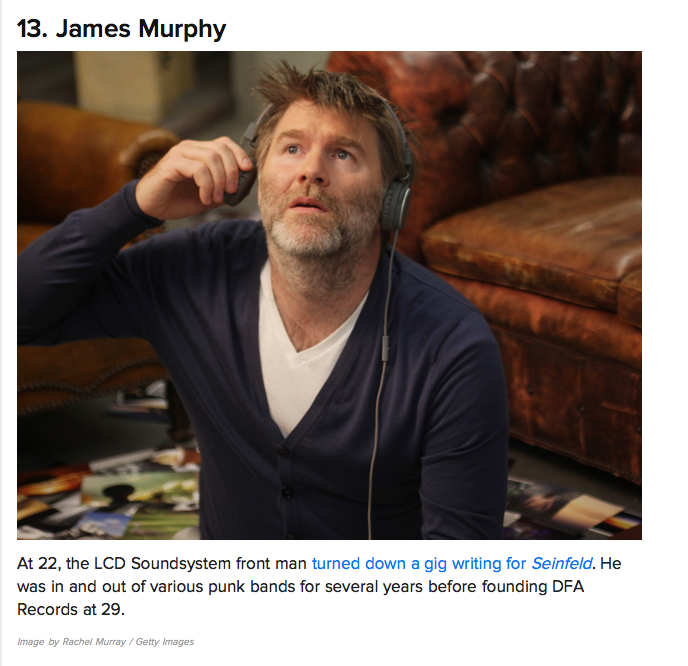
Buzzfeed posted a list recently of “19 Successful People Who Had a Rough Time in Their Twenties,” and while it’s mostly nice (who doesn’t like to hear about people having a hard time?) there’s one entry I would like to take exception with, and that is the following:

Also, I think he might be a douche.

Also, I think he might be a douche.

See now, they’re saying he had a tough time because he bounced around punk bands but a) he also had an enormous opportunity at 22, which would have provided an ego boost on which to coast for at least a little while, whereas a lot of the rest of us do naught but contemplate suicide or religious service for five-ten yeras and b) he founded DFA Records at 29, which technically is still a part of one’s twenties.  The biggest annoyance here is that HE WAS OFFERED A JOB WRITING FOR SEINFELD AT 22!  That’s not exactly a “rough time,” regardless of whether or not you accept the job.

Liveblogging the Trailer

July 1, 2013

The first in a series!  Herewith, the trailer for Salinger:

RECLUSE!

PAPARAZZO!

SALINGER!

PAPRAZZO!

CATCHER IN THE RYE!

ADOLESCENT ANGST!

SILENCE!

DISAPPEARANCE!

HOWARD HUGHES!

NAZIS?

NAZIS!

NERVOUS BREAKDOWN!

CONCRETE BUNKER!

FANATICS!

ASSASSINATIONS!

MARK DAVID CHAPMAN!

DELUSIONS OF GRANDEUR!

LOVE AFFAIRS!

SECRET MANUSCRIPTS?

VAULT?

SECRET MANUSCRIPTS!

ANNOYED

June 11, 2013

So I was looking at a list of review books available for me to critique when I came to a book by documentary filmmaker Polly Morland called The Society of Timid Souls: Or, How To Be Brave.  The synopsis is as follows:

With The Society of Timid Souls, or How To Be Brave, documentary filmmaker Polly Morland sets out to investigate bravery, a quality that she has always felt she lacked.  The book takes inspiration from a vividly eccentric, and radical, self-help group for stage-frightened performers in 1940s Manhattan, which coincided with the terrifying height of World War II and was called The Society of Timid Souls.  Seventy years later, as anxiety about everything from terrorism to economic meltdown continues, Morland argues that courage has become a virtue in crisis.  We are, she says, all Timid Souls now.

Despite a career in which she has filmed in rebel-held Colombian jungles and at the edge of Balkan mass graves, interviewing convicted murderers, drug-traffickers, and terrorists, Morland herself has never felt brave.  Often, the very reverse.  So she sets out to discover how and why courage is achieved in an age of anxiety and whether it might even be learned.  Drawing on her interviews and encounters with soldiers and civilians, bullfighters and big-wave surfers, dissidents fighting for freedom and cancer patients fighting for their lives, Morland examines bravery across the spectrum: from the first childhood act of defiance by Bernard Lafayette, a leader of the civil rights movement who later faced down the KKK in Alabama, or the reflexive will-to-survive of  Vjollca Berisha, a Kosovo Albanian who endured a massacre by playing dead among the bodies of her own family, to the small acts of everyday bravery that quietly punctuate our lives, in schoolyards, labor wards, and hospices the world over.

Along the way, Morland draws attention to some of the myths of bravery that have been conjured and perpetuated over time and argues that, often, courage exists as much in the telling as in the doing.  At once an exploration of what bravery means and a chronicle of the author’s personal journey among those who embody it, The Society of Timid Souls is a profound, approachable meditation on this most valued and mysterious of human qualities.  In setting off on the trail of the lionhearted, Polly Morland finds out a great deal about what makes some of us extraordinary, and what of the extraordinary we all share.

So naturally the most interesting thing about this to me was the title, and the original Society of Timid Souls mentioned in the first paragraph.  (The book itself sounds kind of self-help-y, and also like a collection of the stories and aphorisms you’d hope to pick out yourself from the news/books you read/world around you, ergo not worth the time to stop living your life to think about how… to live your life.)  Unfortunately, now, if you Google “Society of Timid Souls,” you ONLY get the book, and not the original society.  Any members still with us?

Foiled Part I-Give-Up

June 10, 2013

I’ve long whined about my desire to write an article on the remaining Branch Davidians, but it looks like NPR beat me to the punch pretty recently.  Dare I say I think my work would have been better than the skeletal piece on NPR?  Some day, I will get the first scoop!

Clive Doyle, a 72-year-old Australian-Texan, still lives in Waco and still has Bible study every Saturday with another survivor, Sheila Martin. Doyle has become the Davidians’ unofficial historian and spokesman. He says they are still waiting on the resurrection of Koresh.

“We survivors of 1993 are looking for David and all those that died either in the shootout or in the fire,” Doyle says. “We believe that God will resurrect this special group.”

Today, all nine Davidian survivors who were convicted for various offenses related to the initial ATF raid have been released from federal prison. Paul Fatta, who spent nearly 13 years in prison on weapons charges, was released two years early for good behavior. Now 55 years old, he lives in San Diego where he manages his family’s Hawaiian restaurant. Fatta, too, still believes.

“I would like to see some divine intervention, for God to vindicate his people,” he says, “all those that have suffered over the years for truth, who’ve been misunderstood, have been mocked, ridiculed [and] thrown in prison.”

I AM A SELF-HATING DESIGN BLOG WHORE

May 16, 2013

Below is an essay that I wrote and couldn’t place anywhere but I still think is hilarious.  I THINK I AM HILARIOUS.

***

I Am a Self-Hating Design Blog Whore


            Anyone who has ever had a desk job knows the lengths to which a person will go to entertain one’s self during that 2-4:30 PM stretch.  Take me, for example: it’s semi-nice outside, but I only know that because I went to get string cheese and Soy Crisps from the deli a few minutes ago, as I reside in a windowless cubicle-esque space.  To distract myself from this burdensome awareness of the weather I now have, I’m reading the 100-page anti-Internet pamphlet published by Kinus Klal Yisrael that was distributed at the Haredi anti-technology (more or less) gathering in CitiField back in May.  Make whatever assumption you wish to about my personal issues from that past sentence; you’re probably right on target.

            Here’s the thing, though: some of this stuff I feel has some validity.  For example, below is a brief instance of how “Internet addiction” has affected the ultra-Orthodox Jewish community:


“A man tells us that his friend… once asked if he could come up to his office to download Shas [6 books of Mishnah] from the computer onto a CD.  The man readily agreed.  So this ben Torah [righteous man] arrived at the office around 5 o’clock in the afternoon and began downloading.  The downloading process was supposed to take about two hours… the next morning, at about 6 AM, when the [man] came back to work, he noticed that the light in the window was on.  He was sure that his friend had left it on by mistake.  When he entered the office, his shock knew no bounds when he found his friend still sitting at the computer, glued to the screen… [The man] decided to be frank with his friend and ask him about it.  His friend shamefully admitted that he did in fact have serious problems every time he found himself with access to the Internet…”


            So I myself don’t black out for twelve hours on memes freshly cooked in a spoon, but I do have somewhat of a similar problem, one which I’m actually trying to white-knuckle through right now: I’m addicted to twee design blogs.

            It started maybe a year ago, when I began work at my first full-time desk job and my friend introduced me to a blog written by a NYC-based mother, cyclist, and erstwhile travel blogger.  I didn’t think much of it, at least at that moment.  In fact, I think I brushed my friend aside with a curt, “This is just way too fluffy for me” and then returned to doing my in-depth, independent study on the etymological development of the word “crazy” from an insult into a compliment (think about it.)  Even my second visit to the blog didn’t raise any red flags for me –– I was just bored, looking to fill a minute or two of dull office time.  Who cares if I was zoning out on a missive about decorating a studio apartment or a montage of pictures that sought to instruct one as to “How to Plan The Best Mother’s Day Brunch?”  At least it wasn’t Facebook.  At least there was some original content there.

            But it was, as is often the case with narcotizing substances, just the beginning.  Within weeks, I found myself drawn back to the blog again and again.  The blogger –– we’ll call her Martha, as in Stewart, in a nod to her nouveau-balaboosta persona –– muses in a cheery, calm way about all things sweet and pretty: middle parts,[1] vintage advertisements, luxury yurts and how to make great fruit-infused water.  “Hm, interesting,” I would nod in a thoughtful way, until I realized that I’m not terribly into either water or fruit, as I prefer the harder shit.  

PINK STAIRS HOW ADORABLE!

PINK STAIRS HOW ADORABLE!

            In fact, I knew right away that I wasn’t into anything this woman is into.  I don’t like bicycles and loathe people who are into their bikes (the one exception being my boyfriend, but we make sacrifices for those we love.)  I’m never going to spend my weekend making my own gemstone-topped bottle stoppers or crafting an online album of my vacation photos and writing cute captions for each pic of me smiling warmly at the camera.  I’ll never vow to try out hot pink lipstick in order to “take a risk” or troll around Etsy to assemble a photo-collage of precious hand-stitched pillows for a baby’s crib (What to Buy For Your Pregnant Best Friend!).  That’s just not me.  More often than not, I’ll spend my free time re-reading Within the Context of No Context or making art out of my tiny, serial killer-esque handwriting or, lest you think I’m all highbrow all the time, lying in my bed with re-runs of The Voice playing in the background and a half-eaten bag of sour cream and onion Kettle Chips (the meant-for-three-or-more bag, not the individual-sized one) next to my face, a film of grease and green flecks of faux-onion coating my limp fingers.  Nope, I would not be spending my Friday evening masterminding a Madewell clothing swap between like-sized friends complete with homemade butterscotch pudding served in cracked little teacups and mango tequila shots taken from thimbles (though tequila is cool.)  Wasn’t going to happen.  And that was okay.  Wasn’t it?

            But just like the young kollel student who eventually needed more than a small Blackberry screen to satisfy his techno-cravings, I soon found Martha’s blog just not enough.  I needed more maternity clothes, more clever dinner party game ideas, despite the fact that, needless to say, I had neither children nor dinner parties.  (Nobody ever said addiction made sense!)  Soon, a number of home design blogs by pseudo-professional decorators were making it onto my regular roll, and my mornings were filled clicking endlessly from picture-of-nice-thing to picture-of-nice-thing.  Ombre nails, cupcake vending machines, a Pinterest collage of rad coffee mugs, a look inside a fellow twee design blogger’s house, photos from the artisanal pencil-sharpening class she attended, affirmations from artistic giants written in red and blue script on an art print I could buy on the cheap, a Tumblr devoted to “top knots”: these images of horror festered inside of me, threatening to overtake me, to rid me of my desire to do things like, oh, I don’t know, download long tracts dedicated to the evils of social media written by religious fanatics.  I began to think, instead, about the design bloggers themselves, their undoubtedly lovely little lives, the way they probably dreamt of re-upholstering chairs with soft, robin’s egg blue cloth at night and woke up fresh and Zen and ready to make ricotta-peach pancakes and serve them to their adorably shaggy husband and toddler.  The biggest problems they broadcasted were akin to “ecru or off-white?”  Occasionally someone would mention post-weaning depression, and that got my darker side going a little bit, but it ended when the writer, despite all the testimonials about actual Depression that claim this is impossible, actually woke up one morning, after two months, and simply felt better!  Back to the real problems: would you ever wear a one-piece bathing suit?

APPLE SANDWICHES ARE CUTE AS BUTTONS

APPLE SANDWICHES ARE CUTE AS BUTTONS

            The final straw was when I started looking at the blog of a particularly attractive ne’er-do-well.  This was the move from e-cocaine –– kind of classy, kept me a little buzzed but still functional –– to e-crack –– a lump of cheap, hard shit that left me brain dead and blubbering.  I checked this woman’s blog every day, and every day, a piece of my soul died, fell off, and decomposed on my office floor.  She basically gave me spiritual leprosy.  Why was this one blogger so much worse than the others?  Because the fact was that she didn’t actually do anything.  At least the other ladies were offering up (organic) recipe ideas or talking about various projects they were involved in; this particular blogger simply posted pictures she took on her iPhone of her (admittedly adorable) two-year-old daughter, geek chic husband and perfectly pouty English bulldog.  Another day, another montage of “My Perfect Family!”: we eat crab cakes at the beach, dip our toes in the sand, and slurp up freshly squeezed lemonade while happily bearing our white-as-printer-paper teeth!  (This blogger is Mormon, as I learned a disproportionate number of the other bloggers whose work I followed were.  I suppose that all that time the rest of us spend boozing and not converting the dead they spend learning HTML and organizing their closets with teak Lazy Susans for shoes?  I would wax further existential on the differences between technophobic haredi Judaism and Mormonism, and the fact that their followers end up on such extreme ends of the blogging spectrum, but I’m saving that for my PhD dissertation.)

            This “final straw” leg of my journey went on for at least three months, until one day, after scrolling through a list of 274 comments to see that almost 90% were composed of the word “cute” followed by anywhere from one to eight exclamation points, I decided enough was enough.  I was powerless over my addiction, and I wasn’t even getting high anymore –– it was just a maintenance plan, something to keep me leveled-off, like an alcoholic’s nip from an airplane-sized whisky bottle in the early morn.  Frame clusters made me feel lonely inside, and any reference to decorative “whimsy” incited a homicidal rage from the pit of my being.  I vowed to go cold turkey on at least this one blog, and I have been sober from it for about two months now.  With great shame, I must admit I still check in on Martha daily, but thanks to the asifa pamphlet, I have a detox plan:


            “I have made the following offer in public, and it stands for anyone reading this essay: if you cannot find someone with whom you are uncomfortable to send the [internet history] reports to, I am willing to read your reports, as long as you are willing to accept some warm divrei mussar [advice]…”


            Rabbi Viener, get ready to have the cutest, most eco-friendly sukkah on the block this year, and by the way, have you ever thought of fishtail braiding your peyos? 


[1] Of course I mean hair parts.

DIY KITCHEN DECORATION

DIY KITCHEN DECORATION

Brilliant

May 6, 2013

I got a submission at the company where I work.  The writer proposes a book for middle-grade readers (8 to 13 years) about French lacemakers.  “In 17th century France,” she writes,”The availability of gold for the garments of the king’s court was replaced with lace created by young girls who were skilled in the art.”

This good idea reminds me of a book I loved as a child about young girls who worked in the wool factories up in Massachusetts.  The girls gossiped, fretted about boys, and fell out with friends. Basically it was like Sweet Valley High but with child labor.  Unfortunately, this query letter is completely incoherent, so I’m posting this and asking someone to steal this idea and run with it.

Some Things

May 5, 2013

Just a couple of things I thought I ought to tell you today:

1. I had a nightmare that I was wearing pants in Borough Park and all the ladies were looking at me aghast.

2. I rode the bus next to a young man today who was telling someone on the phone about his friend who “runs an organic underwear washing business.”

3. I realize I missed a huge professional opportunity while reading The Unabridged Journals of Sylvia Plath.  “[This] text is a an exact transcription of twenty-three original manuscripts in the Sylvia Plath Collection at Smith College in Northampton, Massachusetts.”  Granted, I was probably too young when this operation was going on, but let it be known that if there are handwritten journals of other poets who committed suicide out there that need to be typed up, I’m your woman.

Drinking with Gary Shteyngart

April 16, 2013

From an interview with Modern Drunkard magazine:

MDM: Back in the old days, that’s how it was. All the writers and journalists were drunks.

GS: Don’t get me started. It’s so hard to be a writer these days. It’s so antiseptic. We’re this sterilized profession, we all know our Amazon.com rankings to the nearest digit. There’s a few people that still keep the tradition going in Brooklyn. It’s a big problem these days. Journalists might drink more than writers.

MDM: They have a hard time admitting it though. At least in print.

GS: True. There are so few people to drink with. The literary community is not backing me up here. I’m all alone. There’s a couple of guys who are strong, but that’s it. It’s so pathetic when I think about my ancestors. Give them a bottle of shampoo and they have a party. And here I am with the best booze available.

Dear Gary Shteyngart,

I will get drunk with you.

Love,

ID

Thoughts on Ghostwriting

April 14, 2013

Re: Craigslist posting that reads:

“~Need someone to help me write a love letter~~

I am not a very talented writer and I need some assistance in writing a love letter to my ex. If you are interested and feel that you could help send a reply.

Compensation: yes”

HS-D: Oh, wow.  I always want to do things like this–same with working for those places who help people write online dating profiles–but then I always worry about the implications of someone else taking credit for that writing.  Not because I want the credit, but because good writing is so attractive, and I feel like it’d be awful to think that the guy you were into was a great writer and then later find out that it wasn’t his writing after all.  A complicated issue.

ID: I know, right?  As an extension of this idea, what if you wrote a really beautiful letter, and it resulted in the couple getting back together, but they were a terrible match for one another and lived a miserable life together, acrimoniously divorcing in middle-aged and forever scarring their children and creating a legacy of domestic unhappiness?

HS-D: Exactly!  On the one hand it doesn’t seem fair to penalize people for poor writing skills, but on the other hand, I feel like it’s almost never a good idea to help people pretend to be something they’re not.

ID: It’s so intimate, too –– a love letter.  I’d have a much easier time ghostwriting hate mail.

HS-D: Oh, definitely.  I have a vague idea that love differs a fair amount from person to person, whereas hate is just hate.

ID: But on the other hand –– “compensation: yes.”