Archive for the ‘I Hate Writing’ Category

Good Conversations Yesterday

January 20, 2017

KM: I’m at [redacted], which is usually a good place to work.  But right now [name of famous writer, redacted] is standing three feet away from me, trying to take a selfie in front of the library.  It’s been going on for almost five minutes.  I’m like, “Can you stop being both annoying and incredibly successful RIGHT next to me???”

ID: Ugh!

ID: I think I would have a hard time [at said redacted location] just for being surrounded by people so successful.

ID: #3 on my list of “neuroses to shed in 2017”

KM: No joke.  She’s still doing it.  I think it must be for Snapchat or a video because she keeps saying “books are magic.”

ID: HAHA

KM: She is remarkably not embarrassed by this.  She’s said it easily 20 times.

KM: Just chipping away at this proposal while this bestseller Snapchats next to me.

***

ID: I straight up don’t believe in [redacted]

AL: Nope.  Fake news!

ID: HAHAHAH

ID: From now on whenever anything I disapprove of comes up I’m just going to yell, “Fake news!”

AL: My friend said her 11-year-old now just yells that at her whenever he doesn’t want to do stuff.

Fact Checking the Internet

December 28, 2016

A few times in the last month or so, I’ve noticed some misinformation––some things big, some small––published on the Internet, and it occurs to me that these mistakes should not go unannounced.  So here I am to dispel them!  To no one!  And to no purpose!  Hurrah!

1. First, this is a small one, but as these initial two errors were both committed by the Guardian‘s film review department (or however they fuck you want to label it) I do think it’s time for them to tighten up the ship a little.  I mean, it’s not THAT difficult to get these details correct.  Here is a review of the latest offering by Rama Burshtein, haredi Israeli director of Fill the Void:

Israeli-American director Rama Burshtein follows her impressive debut, Fill the Void – a drama about marriage set in Jerusalem’s Haredi community – with another picture dealing with relationships set against an orthodox Jewish backdrop.

Fill the Void was set in Tel Aviv, not in Jerusalem.  I get the mistake (you hear “haredi,” you think Jerusalem) but it was well-reported that it was in Tel Aviv, so just Google it, will ya?

2. Ah, Peter Bradshaw.  How many loathe thee for thy spoilers!  Personally I don’t have a dog in that fight, although I do question how you made such a simple error in this review of Nocturnal Animals:

The clash between supercool LA and this couldn’t be more jarring. Because this is no feathery literary confection: it is a brutal west Texas crime thriller about a married man – Susan imagines Tony, that is, Jake Gyllenhaal in the role, who takes his wife Laura (Isla Fisher) and his daughter Helen (Ellie Bamber) on a road trip on vacation across the remote desert, where they are terrorised by a wild gang of good ol’ boys led by the brutish Ray (Aaron Taylor-Johnson).

Ellie Bamber’s character is named India, not Helen.  Not even a little close.

3. In a recent book titled Bellevue: Three Centuries of Medicine and Mayhem at America’s Most Storied Hospital, writer David Oshinsky says that Sylvia Plath was one of the many celebrities hospitalized there after her breakdown.  He only mentions it once, in passing, in the introduction.  I have read Plath’s collected journals, as well as the many biographies of her that have been written over the preceding twenty years (side note: Levy Center fellow Heather Clark is obviously an expert, but what on earth do we not know about Sylvia Plath’s life by now?!) and I don’t recall any mention of Bellevue.  So I digitally searched for the word in five biographies of her, and again, found nothing.  I suspect that Mr. Oshinsky just read that piece of misinformation somewhere, thought it sounded plausible (which it does) and sexy, and added it in.  And for the record, I’m not the only one who questions Oshinsky’s sourcing, as New York Times critic Jennifer Senior calls it “inexplicably sloppy.”  So there.

I was also about to rail against those who claimed Simone Weil was a convert to Catholicism, although with further research it appears that in fact I was probably wrong about this, and I’ve decided to fess up to prove that even the best among us make mistakes!

I’m missing a few instances here, but it’s best not to get too caught up in petty things.

An Amazon Review Is My New Characterization

November 9, 2016

Re-reading bad Amazon reviews of a wildly successful memoir (that I have zero intention of buying/reading), I find one that basically sums up my experience with most things.  If I had a Twitter account, my sub-header would be, “I couldn’t get into it but everyone else I know loves it.”  Maybe that only applies to books though.

You’re welcome for the only thing you’ll read today that isn’t about the election.

Contract for Potential Correspondent

November 6, 2016

I, ____, heretofore referred to as CORRESPONDENT, have agreed to enter into a written correspondent with Itinerant Daughter, heretofore known as ID.  Upon signing this contract, CORRESPONDENT agrees to the following stipulations:

  1. CORRESPONDENT will feel emotionally invested in the quality of the prose
  2. CORRESPONDENT will feel at least a twinge of guilt when not responding to a note (email or letter) in a timely manner
  3. Despite point number two, CORRESPONDENT will not be under any obligation to respond to any piece of communication in a timely manner, provided that:

3A. CORRESPONDENT agrees not to communicate displeasure with ID via silence or     refusal to engage to written correspondence.  CORRESPONDENT can only opt out of relationship and written engagement via a clear message (medium is the choice of CORRESPONDENT) indicating such.

In turn, ID agrees:

  1. To never assume that CORRESPONDENT’s delay in response is indicative of anything other than CORRESPONDENT’s very busy life.
  2. To never guilt CORRESPONDENT into sending response
  3. To also only communicate termination of correspondence via clear written message (although knowing ID, this will not happen, as she has never met an epistolary relationship she couldn’t carry on.)

Signed and dated:

_______________                   _________________

CORRESPONDENT                        ID

The Joys of Dissent

October 5, 2016

Shit, it’s been a while.  Since I last posted, Elena Ferrante’s been unmasked, Kim Kardashian’s been robbed, and Brangelina has been pronounced dead on arrival (little airplane joke there).  When I came to look at the date of my last post just now, I felt so guilty that I decided I simply must put something up now.  But the problem is I don’t have a ton to say.  Well, here’s one thing: everyone knows I’m something of a contrarian, right?  Maybe this was a personality trait that excited me in the past, but in recent years, it’s proven more annoying than anything else.  If only I could get on board the zeitgeist train, I could write anodyne personal essays about ending the stigma (surrounding anything) and not worry that I’m harsh!

I don’t know if that’s going to happen anytime soon, though.  In the meantime, I’ll just have to find a little joy in reading negative reviews of books everyone else in the world adored.  Case in point: a review of When Breath Becomes Air by Paul Kalanathi in the London Review of Books.  WBBA was gushed over by basically every literary critic and human in the United States, but writer Thomas Laqueur was meh on the whole thing.

“It’s time to confess the obvious: I wasn’t deeply moved by this book.  But it isn’t easy to explain why.  the first thing that comes to mind is that I find the author pompous, and, whether a true or a faux naif, egomaniacally self-conscious in his search for meaning… A larger problem is that Kalanathi isn’t very good at writing.  Having done so little of it, why should he be?  As Julian Barnes wrote in his introduction to Daudet’s memoir, dying doesn’t make someone a better writer, or a worse one for that matter.”

This made a lot of sense to me because of my longstanding aversion to our immediate embrace of suffering narrators (because pain doesn’t make you smarter, necessarily, but it does mean people feel less justified in critiquing you, even when that criticism is deserved, which results in a lot of thoughtless applause).  But it also reminded me of the extended period of time I spent in my mid-twenties working with someone terminally ill (who is now deceased), I was always half-anticipating a big life epiphany, courtesy of the Sick Person, every day, but most of the time it was just the usual drudgery and the Sick Person remained their flawed, human self, right up to the very end.

Essays No One Would Publish

September 21, 2016

Again, only tried once, but it was enough of a burn that I didn’t take it further.  But I’m definitely amused at myself upon re-read.  One of our dining companions from then (this was written a few years ago) was worried it would be too snarky about the group––sorry, JW!

Reviews of Restaurants Run by Cults

We’re pleased to present our first episode in “Mouthwashed!,” a series of reviews of cult-run restaurants. This week, the Spiritually Adventurous Eater visits the Yellow Deli in Rutland, Vermont, run by a group known as the Twelve Tribes.

“Would you guys like a table?”
“Yes, for four.”
“That’s so nice!”

As the Spiritually Adventurous Eater, I am accustomed to establishments

with creepily friendly staff members, but the Yellow Deli in Rutland, Vermont, manages to exceed even my expectations. The host, a middle-aged bespectacled man with a ponytail, is so enthusiastic about our arrival I momentarily worry he might throw out his back. But instead he snaps up a couple of menus (“We serve the fruit of the spirit!”) and leads our party of four (future-Jew, Jew, recovering Catholic and atheist) through a maze of woven textiles and repurposed tree branches to our booth, shaded from the low light of the main room by a faux-roof like a hobbit hovel. As you’ll probably have noticed by now, the most bizarre and fascinating thing about this place is the décor. The only way I can think to sum it up is this: if the set designer of Willow had a love child with sixties activist group Another Mother for Peace, it would look like the inside of the Yellow Deli. No wait, another way: if Shelley Duvall’s Faerie Tale Theatre ate a plate of Margaret and Walter Keane paintings and then took a shit in a twee forest, it would look like the inside of the Yellow Deli. Wait, sorry, just one more: if David the Gnome was on acid at a Phil Lesh and Friends concert, his hallucinations would look like the inside of the Yellow Deli.

All this is somewhat unnerving to me, as a person with a natural threshold for kitsch, but I am comforted to see little unfamiliar about the menu. The Yellow Deli––one of eleven in the United States, Canada and Australia––features typical American cafe fare like sandwiches, salads, chili and a small selection of breakfast items. There are a few nods to hippie Vermont in the form of maté blends, “green drink,” and the fact that one sandwich is named the “Deli Rose,” but other than that, an unassuming patron would be hard-pressed to recognize how seriously the proprietors take their peace-and-love ethos. Hard-pressed, that is, unless they were to take a quick jaunt to the bathroom, wherein they could partake of a variety of free “literature” while they waited to use the facilities. The newspapers and pamphlets available outline––however vaguely––the beliefs of the Twelve Tribes, known in some areas as the “Yashuas,” who run the chain of Yellow Delis in addition to a handful of coffee shops, hostels, tanneries and organic food markets throughout the United States and the world. The Twelve Tribes began somewhat organically (no pun intended) in Chattanooga, Tennessee in the early seventies, one of a few individual attempts within the “Jesus Movement” to blend hippie culture with Protestant ideals. The group has a long history in the food industry; its original members gathered at a coffee shop called The Lighthouse, run out of the home of longtime church leaders Gene and Marsha Spriggs, before founding the first Yellow Deli. Though they have recently branched out into real estate development and construction, the Delis have all but financially sustained the Twelve Tribes, who consider all possessions and earnings communal, for almost forty years.

On my walk back to the table, I pass by the counter, and watch as uncharacteristically mean-looking women, dressed in palazzo pants and dowdy Amish-esque tops, slap together cold cuts and bread for sandwiches. Our happy waiter is at our table when I return, ready to take our order, a giant red flower on the end of his pen shaking as he hastens to write down our requests. No beer on tap, of course––Twelve Tribers don’t drink alcohol, and they follow certain Levitical dietary laws, like eschewing pork and shellfish––but you can get a frosty mug of root beer if you’ve a hankering. We order sandwiches and veggie burgers, which a young smiling woman brings over to us within fifteen minutes. The presentation is crunchy-snack-bar––sandwiches in woven baskets, accompanied by the requisite piles of Lays chips and a pickle.

“Oh yes, table ‘iron,’ this is yours,” she says. “Where are you guys from?”

“Brooklyn,” I respond.

“We have a farmer’s market there, in Brooklyn. We sell green drink.” She seems to think that I might know it, but I explain to her that Brooklyn is quite large, and there are many, many farmer’s markets there.

“But I’ll look out for you guys… ?” I offer, and at this she seems calmed. Only after she’s gone do I realize there are tomatoes on my sandwich even though the menu had said there weren’t, but when I meekly get the host’s attention and he answers, “With all my heart?” I decide to just dump the slabs on my boyfriend’s plate. One member of our party insists his sandwich is “succulent,” though mine has much more in common with a packaged lunch you’d buy at an airport terminal than a prime rib. When I order banana bread for dessert and realize it’s almost certainly microwaved, I realize the crux of my disappointment: I had expected these happy little cult members were waking up early to bake bread––recipe calls for a dash of cardamom, a handful of walnuts and a pinch of love––but in fact, most of their fare tastes like it comes right off the shelf at the nearby Shaw’s. A follow-up call to the Twelve Tribes’s toll-free hotline confirms that while they do cook with goods from their farm when possible, more often than not, they buy commercial. All in all, I feel duped, just as I had when, at eight or nine, I realized that in fact David Bowie was not, in fact, king of the goblins.

Our check comes out. It’s yellow, of course, and embellished with little smiley faces and a big thought bubble emblazoned with the words, “We are here for you!” But the fruit of the spirit? Ain’t that tasty.


Grades:

Décor:                         8 out of 10
Cuisine                       4 out of 10

Service:                       6 out of 10
Proselytizing:             2 out of 10 (they didn’t try nearly hared enough to win us over, in my view)

Future columns will be the same form, reviewing the following:

The Merry Wives Café, in Hildale, Utah

The Scientology Celebrity Centre Sunday brunch, in Los Angeles, California

Golden Era in San Francisco, California

Der Dutchman Café in Holmes County, Ohio
Soapbox

August 30, 2016

Guys, I don’t want to be a curmudgeon, always hating on things that purport to be put forward for our comfort.  I really don’t.  But you force me into this position sometimes.  Case in point: a recent Refinery29 article on miscarrying in your twenties.  It’s a special problem, they say, despite recognizing that it’s much rarer to miscarry in your twenties than your thirties (1 in 10 for the former, 1 in 4 for the latter.)  Why is it special?  Because it’s isolating, because you don’t have the “life experience” to know how to handle it, because, as one interviewee says, you want to “choose when [you] become a mum.”  But what about a miscarriage at forty?  Also isolating, also you’d like to choose to be a mum (I mean, if the world were perfect, we’d all choose everything) and to balance out that whole life experience thing, the horror of knowing you might not have much time left, which just isn’t the case when you’re twenty-three.  People say stupid things to try to comfort you when you’re twenty-three, but they do when you’re forty-three, too, I’m guessing; people say stupid things all the time, and they will continue to say them for as long as the great world spins.

I’m not saying it isn’t emotionally devastating to miscarry, or to deal with any loss or tragedy.  I’m just saying that this is an example of the media pretending that these are new, sexy problems that need special attention, when in reality they are just dragged out into the light again so that the publication can attract new eyeballs (=clicks) by pretending they’ve unearthed some heretofore uncharted landscape of human suffering (see also: the Telegraph’s article on “anorexia athletica,” which highlights an unrecognized problem that has nevertheless been in the news for decades now, cannot statistically be said to be on the “rise,” and is oftentimes just a facet of anorexia nervosa, which they can’t use in the headline because that diagnosis has lost its luster as a subject as it’s been reported to death.)

But don’t take it from me––take it from my prophet bestie George W.S. Trow, BDE, who saw this shit coming a mile away.

Important Programming

Important programming is programming that recognizes the problem.

Important Programming

It if is just a problem––teenage alcoholics who need to talk to Matron––then it is a little boring after a while, because it is only half of the problem.  The the problem might have to be doubled.  You might have to add Angel Dust or Runaways or Child Abuse.  You might have to, because just the problem is only half of the problem.

Experts

The problem is offered up to authority for healing.  But Pepper shies away from healing, and so does Matron.  They conduct the problem to other experts.  The experts shy away a little, too.  Who would have thought it?  “We move toward a full discussion of the problem,” they murmur.  “During this discussion, you will experience a little sense of home.  Do you feel it now?  No?  Then perhaps our discussion has not been full.  Is that perhaps your fault?”
“In what lies your authority?” a willfull person asks after a time.

“Why, in the problem,” an expert answers honestly.

Important Programming

The most important programming deals with people with a serious problem who make it to the Olympics.  It is the powerful metaphor of our time––babies given up for dead who struggle toward a national life and make it just for a minute.  It’s a long distance to come.  People feel it very deeply and cheer the babies on.

Problems

An important question to ask about an association of individuals is, “How does it spend its best energies?”  One can imagine many answers to this question.  One answer, certainly, would be “Dealing with problems.”  One would expect this answer from, for instance, a poor association of individuals or an association without ambition.  But even from associations as impoverished as these associations might be, one would not expect the answer “Aspiring to love problems.”


סרט מפחיד

July 6, 2016

I’ve been envisioning, for a few months now, a horror film set in Bnei Brak or in Mea Shearim, in Jerusalem.  I suppose it’s because I am a horror buff and because I mused to a friend that I wanted to write my own scary movie, and she asked where it would take place.   I knew the setting had to be inherently eerie because I love the work the ambiance can do in film, particularly in horror.  Think: Polanski’s Dakota, Kubrick’s Overlook Hotel and surrounding Colorado mountains, Gore Verbinski’s Biblically rainy Seattle, David Robert Mitchell’s Detroit of an indeterminate era.  Don’t you think Bnei Brak at night would be terrifying?

APTOPIX MIDEAST ISRAEL INDIA SHOOTING REAX

Not the villains

.

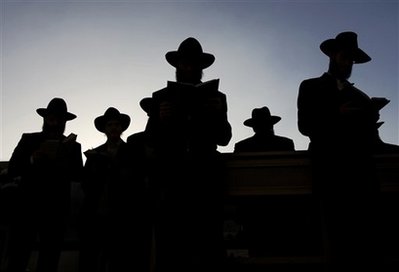
Men crowding the streets for one thing or another, as haredim are wont to do––good premise for a scene!

selichos1

Casting call

I don’t know the plot yet, at all, except that I want it to center around a young boy, between eight and eleven years old, who is the only one who notices the uncanny events unfolding around him.  It can’t be anything reminiscent of a demonic possession, as that gets too close to dybbuk stuff, and in addition to being too simple for me, is the premise for Demon, which appears to be a nail-biter.  I am culturally literate but will definitely need a co-writer for this sucker.  How about Yehonatan Indursky?  He’s not busy, is he?

Oh!  And how I could I forget the decaying Danvers State in Session 9, my most favorite horror flick of all time?!

Did You Write Your Memoirs by Hand?

June 28, 2016

Apparently I saved a draft of a post with this title three months ago.  Maybe it was about Amish memoirist Marlene Miller?  Or maybe about something else?  I hope the latter, because I’m having fun imagining what that something else could have been…

Snuff Films/Writer Problems

June 15, 2016

So a few days ago, I was working on a piece in which I wanted to insert a little joke about the terrible nineties flick 8MM starring Nicholas Cage, and then I decided that in order to make sure the joke was accurate, I had to re-watch 8MM.  (But I didn’t, really.)  Then, halfway through the film, I was hit with one of those urges to Google something inappropriate.  We all know that feeling: you’re watching Law and Order: SVU, and you think to yourself, “Is NAMBLA really real?!”  And then you go to type in “North American Man Boy Love Association” into your search bar and realized, “Oh shit, what if someone thinks I’m actually looking for NAMBLA as opposed to just, well, verifying that NAMBLA is a thing?”  Or perhaps you’re trying to write a short story about someone who builds a bomb, but you have zero idea how to build a bomb yourself, so you go to the library, but then remember that checking out The Anarchist’s Cookbook might get your name on quite a few government lists.

But the other night, my inhibitions lowered by lack of sleep, and also comforted by the fact that probably a million people have Googled “snuff film” before, I went for it.  And one of the first hits was this random story on Reddit, which I thought, in my delirium, might be true but of course it’s just the ramblings of a horror writer trying to drum up a few readers by pulling the old “it’s true, really!” card.  Still, someone should consider making a movie of it.  Nic Cage could star.

Please, please believe me.

My Dad was an odd man, quiet , reclusive and with a weird sense of humour. But it was a safe strangeness, a slight eccentricity that I assumed all aging fathers had.The strangest thing about him was the fact that his left hand only had a thumb, a forefinger and a little finger. He never explained what happened, and the one time I was to ask – when I was nearing 16 – he very calmly stared at me and told me to never ask again. It was the type of calm that chills you, the type of calm that’s only formed through utter, utter rage. I’d asked my Mum about it and she’d always quietly replied “Ask your father.”. Apart from that he was relatively normal.

My Dad used to stay up late, watching old VHS’ in the attic whilst we (my mother and I) went about our business downstairs, me playing on the computer and her cooking, or whatever she got up to. The room at the top of the House, essentially a converted attic was his domain. My Dad didn’t ask much, but that room was his and only his. My and my Mum were never, ever allowed in. I took it for granted at the time, assumed everyone had their ‘me’ place, and for the most part brushed it off. I was never allowed into the top room – I assumed when I was younger it was because it was his secret lair, though as I grew older I thought he could be watching porn.

The truth is far more sinister.

My Dad never left the house except for working whilst I was at school, he didn’t seem to have many friends and so I never had a chance to see what he was really hiding. I tried once to look for Christmas presents, and once more when I was older… for porn. Both times the door was locked, firmly and the thought of my Dad finding me looking made me terrified. His temper flared rarely, and nastily.

After bunking off school after lunch to finish a project at the fine age of 19 to finally conquer the room, driven by a desire for independence and to satisfy my endless curiousity. I got in today. My Dad was at work, and judging by the half finished bottle of whiskey sitting on the stairs, he’d been drinking. He forgot to lock the door, which was a rarity. The past times I’d tried the door was double locked, but I assumed that in the rush my Dad had simply forgotten to lock it- assuming I’d be out all day. On opening I was assuming something dark and dangerous would appear, I’d see a dead body – or something hiedous, but instead all there was was a box of old VHS a faded armchair, and an old, large TV.

I instantly leapt to the videos, knowing I didn’t have much time and that my Dad would be furious if he was to find me looking through them. I found a large amount of old movies, old taped TV shows – I was about to give up – until I found a tape simply labelled, in childish, scrawled hand ‘PACT’. The reason I noticed it was that it was clean, the white case it was in was dog-eared, but clean. All the other videos were dusty but in pristine condition, and this film hidden at the bottom seemed to have been watched over and over.
Taking a deep breath, and listening to hear if the door unlocked I slipped it into the TV.

This is where it gets weird…