Cats

September 15, 2017

I love a good public cat.  What do I mean by “public cat”?  I mean bodega cats, cats that live in museums (like the Hermitage), cats like Larry and Palmerston, who live in Downing Street, etc.  My favorite public cats of all, though, are hotel cats.  Just a brief aside before I tell you about my favorite hotel cat: when we were in Provence this summer, my husband and I went to dinner at a very fancy hotel restaurant.  A number of the diners had dogs with them––including two women wearing head-to-toe designer gear with tiny Yorkies sitting on their laps––and yet, the restaurant had a cat roaming around.  If that was a passive-aggressive move by the owner of said hotel, I bow down to you, sir.

Anyway, obviously my favorite hotel cat of all time is Matilda, of the Algonquin in NYC.  The Algonquin has kept cats since the 1930s, and has had three Matildas (and seven Hamlets, but more on that in a bit).  When I was a regular, Matilda was a very coy rag doll beauty who had her own chaise lounge and would only reluctantly let me pet her.  According to this piece (which, side note, I’m very jealous I didn’t write), Matilda has stalkers… er, fans, who send her rather elaborate gifts:

There was a lady in Japan that hand-made an exact replica of her, two dolls, out of wool. Each strand of wool, strand by strand, she put those in. It looks exactly like Matilda. One is just Matilda, we have her in the showcase out front. And then I have one up here where she has her in a kimono.

But the Matilda I knew and loved is on her way to retirement, and a Hamlet has taken her post!  As per Algonquin’s Instagram:

IMG-20170801-WA0005

This Hamlet is one lucky guy!  Agreed that some may find his appearance a bit drab after the glam Tildy, but according to the official Algonquin cat wrangler, he’s a real charmer!  Sad to have missed his inauguration, but Hamlet––here’s to a martini together in the near future.

Wisdom in Folly

September 3, 2017

The first Chelmites could neither read nor write, and the history of those ancient times was never recordered.  It is said that these earliest Chelmites were primitive people.  They walked around naked and barefoot, lived in caves, and hunted animals with axes and spears made of stone.  They often starved and were sick.  But since the word “crisis” did not exist yet, there were no crises and no one tried to solve them.

After many, many years the Chelmites became civilized.  They learned to read and write, and such words as “problem” and “crisis” were created.  The moment the word “crisis” appeared in the language, the people realized there was a crisis in Chelm.  They saw that things were not good in their town.  The inventor of these words was a man called Gronam.  Or, as he is known, Gronam the First.  He was also called Gronam Ox because he sported a headdress with the horns of an ox.

Groans was the first sage of Chelm, as well as its first ruler.  In Chelm, rulership and wisdom have always gone together.  A council of five sages helped Gronam govern.  They were: Dopey Lekish, Zeinvel Ninny, Trestle Fool, Sender Donkey, and Shmendrick Numskull.  Groans also had a secretary, who was called Shlemiel.

One day Gronam ordered Shlemiel to summon the sages to a council.

When they assembled, Gronam said, “My sages, there is a crisis in Chelm.  Most of our citizens haven’t enough bread to eat, they are dressed in rags, and many of them are suffering from coughs and sniffles.  How can we solve this crisis?”

The sages thought for seven days and seven nights, as was their custom.

Then Gronam said, “The time is up.  Let me hear what you have to say.”

Dopey Lekisch was the first to speak.  “There are only a few people in Chelm educated enough to know that ‘crisis’ means a bad situation.  Let’s make a law forbidding the word’s use, and it will soon be forgotten.  Then no one will know that there is a crisis, and we the sages will not have to rack our brains to solve it.”

“Too late,” Zeinvel Ninny interrupted.  “It is true that the old people don’t know the word, but the younger generation have all learned it, and they represent the future of Chelm.”

The Fools of Chelm and Their History by Isaac Bashevis Singer

Putting My Career Up To a Vote

August 30, 2017

What would make a better biting provocative essay: “Against Therapy” or “Against Oprah”?

Burn Down the Future, Part XXVCICX

August 29, 2017

I think I’ve mentioned to y’all before how much I loathe Gmail’s new “suggested responses”––humans are so lazy and uncreative, I guess, that they need to be able to press one button instead of the thirteen it takes to write, “Great, thanks!”––so it pleases me enormously when I manage to have an exchange Gmail cannot fathom.  Yesterday, for example, I sent my friend an article about a woman with Munchausen’s by Proxy whose proxy was her cocker spaniel, and she responded, “Yeah, I’ve heard of this before, mostly in old ladies.”  And Gmail said I should be responding, “Cool!” or “Thanks for the tip!”

The All Souls Game

August 24, 2017

Last weekend, my husband and I went to Oxford for the day, and on our (excellent) two-hour free walking tour, the guide stopped us at the gate to All Souls College and explained a bit about it.  All Souls College is a graduate school, kind of.  The description of it actually sounds a bit more like an elitist club, where “fellows” are just distinguished people from their fields (in other words, how much studying is happening, I can’t really tell).  The entrance exam for All Souls famously used to be a single word that you had to free associate on in an essay.  You had three hours to write this essay, which goes to show you how deep the graders wanted you to go on the topic of “water” or “style” (both real prompts.)  Apparently, they scrapped the one word exam back in 2010––a very funny article about it is here––but they still do these very broad questions that are sometimes interesting, sometimes amusing, and sometimes sound like the kinds of queries stoned college kids pose to each other while sitting bleary-eyed beneath that poster where those naked girls have Pink Floyd album cover painted on their butts.

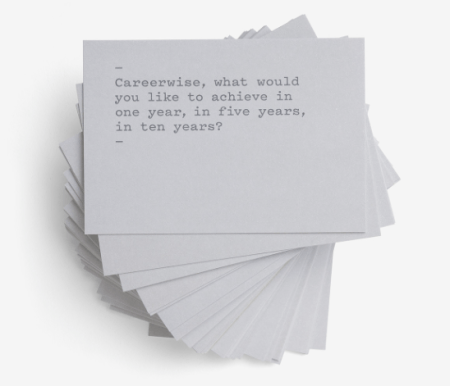
So of course my husband and I were like, “Shit, it would be kind of fun to just take the exam and see what happens!”  But obviously we will never get that chance.  However, I thought, perhaps we can all have the experience of taking what has often been called the hardest test in the world.  What if there were a cleverly designed pack of question cards, like the one The School of Life (which I hate, but their branding is good, I admit) makes about untranslatable words and confidence and shit like that, but instead of those things, it was some questions from All Souls exams, and you could break these out at your next dinner party before intoning, “THE GAME’S AFOOT”?  (That would be required.)  I mean, I’d do it.  Would you?

Screen Shot 2017-08-23 at 10.20.23 PM

Design example

Screen Shot 2017-08-23 at 10.20.33 PM

Second

Here is a link to some sample exams, and here are a few of the better questions I’ve picked out:

Is eugenics ever a good thing?

Is there anything to be said for astrology?

Should we preserve living creatures harmful to human interests, such as the tick, the locust and the tapeworm?

In the context of political speech, ‘[e]ven material which causes a significant degree of revulsion may be justified by the serious purpose of the context in which the material is broadcast’: Lord Walker in R. (ProLife Alliance) v. B.B.C. [2003] 2 WLR 1403. Do you agree?

Should parents be punished for the truancy of their children?

Should prisoners have the vote?

Where should the boundaries lie between a person’s private and public life?

Would you ban a book?

Is your belief in the theory of evolution based on faith or reason?

Should tigers be saved at the expense of Indian villagers?

Should there be a market in human organs?

Does the moral character of an orgy change when the participants wear Nazi uniforms?

(This last one isn’t in those sample tests, but was cited by Sarah Lyall––link above––as a past question.  And I think the answer is DUH.  Nazi uniforms change every single situation.  Also this would obviously be the first card I picked out when I had people over.)


A Typical Exchange

August 23, 2017

Me: I might need you to come home early on Monday night because I might be on that radio show about self-esteem.

Husband (scoffing): What are you going to say, that you don’t have any and you don’t believe in the concept?

Me: … maybe.

Pictures of Racists Looking Dumb

August 19, 2017
Screen Shot 2017-08-17 at 8.43.09 AM

MILK WAS A BAD CHOICE

The Unrated

August 14, 2017

This is probably the longest I’ve gone without blogging in years.  But in my defense, I was in Provence watching bullfights (true story!) and dealing with a teething four-month-old. I’m kind of a boring bougie asshole, aren’t I?

But no matter.  For whatever it’s worth, I’ve thought a lot about blogging, but lacked the resources (good WiFi, a moment to myself during which I’ve had use of both hands) to do it.  Most of the things I’ve considered noting down are lost to the sands of time, but I do remember this one: while in France, I read Chuck Klosterman’s book But What If We’re Wrong? Thinking About the Present As If It Were the Past, which is oodles of fun, especially if you’re a contrarian who hates the present as much as I do.  Anyway, here was one nugget I found enjoyable to contemplate.  He’s talking about which writers might be posthumously wrenched from an obscurity which is a byproduct of their marginal social position:

“The uncomfortable, omnipresent reality within any conversation about representation is that the most underrepresented subcultures are the ones that don’t even enter into the conversation.  They are, by definition, impossible to quantify.  They are groups of people whom––right now, in the present tense––it is still acceptable to dislike or discount or ignore.  They are groups who are not seen as needing protection or support, which makes them vulnerable to ridicule and attack.  Who are they?  As already stated in this paragraph, I am in no position to say.  If I try, I can only be wrong.  Any argument in their favor is an argument against my premise.

Still, the history of ideas tells us that there are many collections of current humans we do not currently humanize.  They exist.  So find them right now, inside your own head: Imagine a certain kind of person or a political faction or a religious sect or a sexual orientation or a social group you have no ethical problem disliking, to the point where you could safely ridicule it in public without fear of censure.

Whatever you imagined is the potential identity of the Contemporary Kafka.  And if your fabricated answer seems especially improbable, it just means you might actually be close.”

When I read this, I thought to myself (perhaps because I’m not creative), “I can’t think of any groups the mainstream reading public”––which tends to be socio-politically liberal––”would easily discount.  All the identifications previously considered aberrant or abhorrent or both are now trumpeted throughout the land.  There might not be any more openly derided––”

And then it hit me: Scientologists.  MIC DROP.  I’m done.

Ideas Machine

July 30, 2017

Once, when I was lamenting to a friend that I didn’t have any projects in the pipeline, she tried to console me by calling me an “ideas machine.”  To which I could only respond by pounding my head forcefully into the nearest hard surface.

But it occurred to me a few weeks ago, that I do in fact have a lot of ideas.  A vast majority of these ideas, however, I am definitely the wrong person to see to completion.  Perhaps there is something like an ideas broker, in which I could maybe sell the ideas to the best candidate?  Here is just a taster of what’s to come:

1. From the Times of London obituary of Helmet Kohl, former German chancellor:

“In late 1944 [Kohl] was sent to a pre-military training camp as part of Hitler’s desperate effort to save the Third Reich by enlisting boys and old men, and ended up in Bavaria. At the war’s end he and three classmates walked 250 miles back to Ludwigshafen through a country in ruins. They scavenged for food, were attacked by liberated Polish prisoners, and saw the bodies of deserters hanging from trees.”

BAM!  Movie.  Right there.  Three boys wander through the German rubble.  Maybe there’s a bear involved, or is that a little too Stand By Me?  Anyway, you’d need to have a thorough, localized understanding of World War II, be able to write adolescent dialog, and speak German.  Well, preferably be German––I think this would work better as a film if it were made in Germany by German filmmakers.

2. Recently I read a long piece in The New Yorker about Augustine, and it commented on how in Confessions, you never hear from his longtime lover and baby mama, who is summarily tossed out of his house when A’s Oedipal nightmare moves in and asserts her power:

The woman with whom he had been living “was torn from my side, because she was supposed to be an obstacle to my marriage,” Augustine writes. “My heart, which had fused with hers, was mutilated by the wound, and I limped along trailing blood.” Of his mistress’s feelings, he gives us no glimpse, noting simply, “She went back to Africa, vowing to you that she would never know another man.” Then she is gone from his account, leaving him with the gnawing sexual appetite that she had served to appease.

So––what about a historical novel from a silent figure?  A la Colm Toibin’s book The Testament of Mary?  This would involve “world-building,” and I do not care to delve into the research on the Roman Empire in North Africa, among other things, enough to do this.  But I think it could be great.  Highest bidder!  (Question: should this service be financially based, or require the applicant to submit a proposal of sorts?)


Yeesh

July 18, 2017

While looking up something about The Glass Menagerie, I found this scathing review of the recent New York production directed by Sam Gold. Hilton Als, tell us how you really feel!

The despair and disgust I felt after seeing the director Sam Gold’s rendition of Tennessee Williams’s 1944 play, “The Glass Menagerie” (at the Belasco), was so debilitating that I couldn’t tell if my confused, hurt fury was caused by the pretentious and callous staging I had just witnessed or if my anger was a result of feeling robbed of the beauty of Williams’s script.