You’re a Good Man, Harold Ramis

January 21, 2014

The director discusses his pretty damn cool background:

From what I’ve read, you had an interesting job after you graduated from Washington University, in St. Louis, in 1966.

I worked in a mental institution in St. Louis, which prepared me well for when I went out to Hollywood to work with actors. People laugh when I say that, but it was actually very good training. And not just with actors; it was good training for just living in the world. It’s knowing how to deal with people who might be reacting in a way that’s connected to anxiety or grief or fear or rage. As a director, you’re dealing with that constantly with actors. But if I were a businessman, I’d probably be applying those same principles to that line of work.

How long did you work at the mental institution?

I worked in the psych ward for about seven months, and then I moved back to Chicago and I began to substitute-teach at a public elementary school—kindergarten through sixth grade. While I was teaching, I did some freelance writing for the Chicago Daily News, and I took a few of these pieces to show to Playboy. They happened to be looking to fill an entry-level editorial staff job, which was joke editor, and they hired me.

The Mirror Stage

January 20, 2014

For the eight-millionth time, I had to look up Lacan’s “Mirror Stage” today to ensure I had the correct definition of it for a piece I’m working on.  It’s one of a couple of things I never trust myself to remember correctly.  (This list includes the meaning of the world “tautology,” and the theology of apostolic Christianity.)  For the record, the mirror stage it seems was actually conceived of by a French psychologist named Henri Wallon, who wrote that “children started to react to their mirror image at the age of four months. By the end of the tenth month he claimed that children actually located a part of their self in their mirror image and that they then imagined that their own body was split into fragments. The child now fell under an inner compulsion, so the argument ran, to unify its ego in space and in order to do this is was forced gradually to subordinate the data of immediate experience to pure representation. The ordeal of the mirror eventually led, according to Wallon, to the child’s entry into the symbolic stage of development.”  (Explanation courtesy the dead cultural historian Richard Webster.)  Simpler version: baby sees image, baby realizes image is HIM, baby starts to control limbs and understand space and physicality.

That isn’t the point of this little post, though.  The real point is to draw attention to how hilarious the graphic Wikipedia chose to accompany its article on the mirror stage is.

Highbrow, lowbrow, folks.

If you don’t get why this is funny, we can’t be friends.

Baby Gift!

January 15, 2014

I got my one friend with a baby––whose seven honorary aunts are likely to spoil the shit out of her––the most adorable little thing.  IT’S A UNICORN HORN!

Made by BrooklynOwl

Made by BrooklynOwl

The version I got is a little clip, so the baby’s going to have to grow some hair first, but still…

A Tweet

January 14, 2014

I like to watch reality shows about cults and then judge the cults for being so “media-friendly.”

While I Search for What I Really Want to Post…

January 13, 2014

… coincidentally, there’s a segment on the very phenomenon described in The Mind of a Mnemonist: A Little Book About a Vast Memory, on CNN right this second!

This is how S., the mnemonist of the title, sees a “zhuk” [Russian for cockroach.]

“… A zhuk––that’s a dented piece in the potty… It’s a piece of rye bread… And in the evening when you turn on the light, that’s also a zhuk, for the entire room isn’t lit up, just a small area, while everything else remains dark––a zhuk.  Warts are also a zhuk… Now I see them sitting before a mirror.  There’s noise, laughter.  There are my eyes staring at me from the mirror––dark––they’re also a zhuk… Now I’m lying in my crib… I hear a shout, noise, threats.  Then someone’s boiling something in the enamel teakettle.  It’s my grandmother making coffee.  First she drops something red into the kettle, then takes it out––a zhuk.  A piece of coal––that’s also a zhuk… I see them lighting candles on the Sabbath.  A candle is burning in the holder, but some of the tallow hasn’t melted yet.  The wick flickers and goes out.  Then everything turns black.  I’m scared, I cry––this is also a zhuk… And when people are sloppy pouring tea, and the drops miss the pot and land on the plates, that’s also a zhuk.”

My Out Of Office

January 7, 2014

Hi!  I regret to inform you that I am unable to respond to a vast majority of emails during the year 2014 as I am developing a secular version of consecrated ermeticism and then immediately inducting myself into the order.  Thanks!  xx ID

Whaddya think, too much?

The Best Book Ever

December 31, 2013

A few months before I left my full-time job, we received two enormous boxes from our distributor––a larger publishing company––that contained more than 200 copies of a book by Paul Volponi called Riker’s High.  The book is about––you guessed it!––a seventeen-year-old who is sent to the high school ward of Riker’s.  When we called the company, they told us to feel free to “donate or discard” the books.  How could they possibly let go of such precious prose?  Below, our hero Martin Stokes tells us about the hierarchy of his unit, what makes a thug, and how to chew when your face has been slashed down the cheek.

A minute later, that kid with the chiseled muscles bounced into the room like he owned it. 

            He looked us up and down and a couple of the kids even took a step backward.  I was sitting on the floor, leaning up against the wall, so I didn’t move.

            “The name’s Cedric, but everybody calls me Brick,” he said, flexing a forearm.  “That’s ‘cause I fall down hard on people.”

            Brick probably wasn’t any stronger than a lot of kids with a decent build.  He just looked harder, and had his thug act wrapped supertight [sic].

            I kept my eyes on him as he talked.  And once it looked like he had everybody else in that room backed down, he began to bark at me.

            “Don’t listen to what the Cos tell you.  I run this house.  You want to use the phone during prime time?  You need a loan till commissary comes?  That’s all me,” he bragged.

            I’d seen kids like him before.  He was a straight-up gangster in what was looking more and more like a soft house.

            “I heard what you did to Jersey,” said Brick.  “I don’t hold it against you.  I could use a real fighter on my payroll.  We’ll talk later.  Okay?”

            But I played him cold and stiff and didn’t say a word.

            That’s when Brick turned to the other kids and said, “Maybe they cut his tongue out, too.”

            They all laughed with him, except for Ritz.  I guess he’d got used to standing alone on Rikers.

            Most kids understand what a thug like Brick can do.  They don’t want to get caught on the wrong side of him.  So they usually play it safe, going along with whatever he says.

            “I’ll check you chumps later,” Brick said, bouncing back out.

            About an hour after that, the Cos called the house out for lunch.

            The mess hall workers were mostly kids from our Sprung.  Brick and his crew had spots at the front of the mess hall line, while I was almost at the rear.  I could see from the mountain of food on their plates that they carried a lot of weight in the house.  We had franks and beans all mixed together, with white bread on the side.

            It hurt like anything to eat with those stitches.  And though I’d shoveled everything into the left side of my mouth, the right side moved along whenever I chewed.

            I finished what they gave me and was still hungry.  But none of the mess hall workers would serve me seconds when I went back. 

            “Who you?” one of them asked.

            “Nobody,” another one answered.

            And I had to stomach watching Brick and his crew toss their trays in the trash, still half full of food.


This Is Part of My Job

December 27, 2013

I am a cultural critic.  It’s probably the most obnoxious job title a person can have––what gives ME the right to critique society?  Nothing, really, other than that I have a decent vocabulary, I’m pretty curmudgeonly, and I elbowed my way into getting paid simply for stating my opinions and developing my own theories.  That, and I’m usually right.

To my budding cultural critics out there: watch the below video of a young girl wowing the audience during an episode of Holland’s Got Talent, and write me a short email answering the following two questions.

1. What is wrong with this video?  (Focus on the part after she starts singing.)

2. What larger flaw in our culture (being Western, intellectual, consumerist, etc. etc.––if you’re reading this, you’re probably in it) does this video’s flaw indicate?

Extra credit: How can we prevent this girl from going by way of Susan Boyle?  (I myself have no idea.  I’m just genuinely curious.)

Good luck, pundits.

Shel Silverstein Was Wild

December 24, 2013

The beloved children’s poet wrote satire, travelogues, and drew erotic cartoons for Playboy.  He also covered Fire Island in a hilarious strip for the aforementioned, which you can see here.  He also wrote a book––out of print!––called Playboy’s Silverstein Around the World.  It’s expensive, but if you have my address, feel free to send it.  Synopsis below.

Yuk yuk.

Yuk yuk.

Displaying the wit and marvelous drawings that made Shel Silverstein one of the most beloved artists of the century, Playboy’s Silverstein Around the World collects and reproduces the twenty-three travel pieces Silverstein created for Playboy between 1957 and 1968.

While children and adults alike know Shel Silverstein for his classic books The Giving Tree, A Light in the Attic, and Where the Sidewalk Ends, they may be less aware that Silverstein also created a dazzling series of illustrated comic travelogues published by Hugh M. Hefner in Playboy. Playboy’s Silverstein Around the World not only reproduces these fascinating articles in facsimile form, it also provides an introduction with never-before-seen photos and drawings and rare, illuminating biographical detail.

Beginning in May 1957 with “Return to Tokyo,” the pieces reproduced in this book took Silverstein from Scandinavia to Africa and the Middle East, from Paris and London to Moscow, ending in the summer of 1968 with the two-part epic “Silverstein Among the Hippies.” This unique collection is a legacy of the close relationship between Silverstein and Hefner, who saw the great potential of this particular combination of artist and assignment, and the social revolution led by Playboy in the 1950s and 1960s.

With its wry, ribald humor and beautifully produced color illustrations, this tableau of the mid-twentieth-century world is sure to please and fascinate Silverstein’s millions of fans.

An Old Girl Crush

December 20, 2013

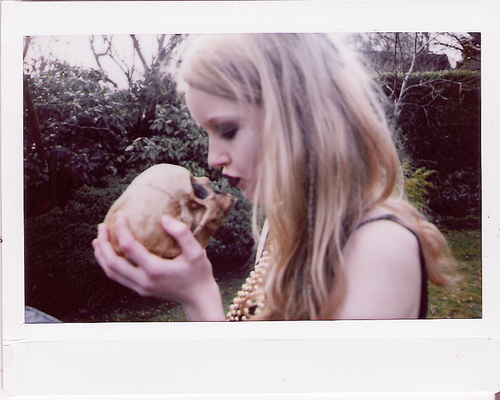
Making out with a skull.

Mwah.

Mwah.

xoxo Thanatos.