Archive for the ‘Things I Love That I Go to Inappropriate Lengths to Track Down’ Category

World, Meet Hipsid: A Cultural Profile

November 20, 2013

File this under: essays no one would publish that I still think are genius!

Crown Heights Frock Swap!

Crown Heights Frock Swap!

            In the summer of 2003, I was in between my freshman and sophomore years of college, living in a dorm near Union Square and mostly forwarding the calls from my internship at a hugely popular television show to my cell phone so I could spend the day watching skateboarders do tricks in the park and eating Tasi-D-Lite.  A friend––I won’t name her, because I’d be throwing her under the bus alongside myself––planned for us to trek out to Williamsburg, which was then being touted as the untapped cool neighborhood.  Here’s the part where I out myself: we both owned a novelty book called The Hipster Handbook, and proclaimed that by summer’s end, we, too, would be hipsters.  One bright Sunday, we took the L out to Bedford Avenue, got out, and strolled around.  We found naught but three shuffling Satmars, ugly, squat buildings, a Hispanic deli, and four slim, pale dudes sporting little glasses and sneers and hawking iced coffee.  We stayed for about 45 minutes, then got bored and went back to Manhattan.

            Fast-forward ten years to today, at which point it seems obvious that the hipster isn’t going anywhere.  It’s not even fun to kvetch about hipsters anymore; that got old around 2010, after a bevvy of writers in publications from the Utne Reader to New York to Rolling Stone weighed in on how annoying and pretentious these American-Spirits-smoking, Grizzly-Bear-loving[1] snarky motherf*^)ers were.  What is interesting, however, is examining the definition of hipster and how it has changed over the years.  The characterization has gone, to simplify, from vague to vaguer.  In 2010, we all knew that hipster-ism had something to do with disaffection, cheap beer, and the most populous of the outer boroughs, but that was as close to a strict definition one could get.  Now, in 2013, we are even further from the comprehensive delineation of hipster than we were three years ago.  Sustainable foodie culture, DIY-ism and Mommy Blogging have all been integrated into hipster culture the way that flour is folded into organic cake batter.  Now, if you live in Brooklyn and are under 40 (or appear to be) you are a hipster.  That is, people believe you to be a hipster if you possess those two criteria, despite your penchant for baggy jeans over skinny, and being labeled a hipster by others is one surefire sign that you are a hipster.  (Denying you’re a hipster is another.)  Whereas I, for example, would not have qualified as a hipster when I was in college ten years ago, technically now I am diagnosable, despite some very un-hip aspects to my personality (examples include being facially animated, loathing indie rock and not really caring when someone assumes I am a hipster.)  

            In the beginning, G-d created Adam, and Adam was a human.  When Eve was fashioned, then we had to use a folk taxonomy to distinguish between types of humans: man, and woman.  Soon, there were many tribes, and then it was important to differentiate the descendents of Shem, Ham, Noah, and Japheth (a hipster name if I ever saw one.)  Like then, we now find ourselves in a position where we have to classify species of hipsters within the already-defined genus.  These species include but are not limited to the following:


Fripsters: hybrid of frat boy and hipster.  Tend to enjoy craft beers, smoked meat, and consuming said at bars where at least one television is playing a sporting event


Yupsters: hybrid of yuppie and hipster (Some use yipster, but I use it only as the diminutive––a tiny yupster.)  Gravitate toward the most-buzzed about locavore restaurant in Bushwick, make six figures working at corporate law firms.  


Hipburbans: Former Brooklynites who have relocated to Beacon, Newburgh, or similar Hudson Valley towns to restore old houses and brew barley wine.


Hip-Hopster: Favors over-sized glasses, kitsch fake gold and old school hip-hop. 


            But there is one type of hipster that has not been given its appellative due.  Ladies and gentlemen, may I (and Dov Charney) present to you the hipsid (alternate spellings: chipsid, chipssid, hipssid.)  You see these hipsids all throughout your familiar hipster Brooklyn haunts: biking in Prospect Park with tzizit swaying in the breeze, drinking beer at Franklin Park on a shidduch date, ornoshing on gourmet pizza at Basil Restaurant (featured in the Times!)  They tend to live on the Prospect Heights/Crown Heights border, so as to be within walking distance of the Franklin Avenue bar scene and Ahavas Yisroel.  They make funny viral videos about facial hair, write tznius fashion blogs, organize skirt swaps, cook elaborate meals with herbs grown in their garden, and clear out warehouses to launch impromptu art exhibitions.  But while the hipsid is into alternative music (preferably live), ironically bright footwear, and organic foodie-ism, unlike his lawless counterpart, the hipsid will only indulge in halachically-sound versions of these things.[2]  Whereas a hipster will listen to indie rock (or whatever it is they/we like) regardless of the performer’s gender, a hipsid dude will make sure the singer isn’t a lady, citing the doctrine of kol isha.  The female hipsid will decorate herself with colorful bangles or a pop of print, but she certainly won’t bare tattooed shoulders by donning baby doll dresses, or wear pants, let alone ones that are strategically torn.  Like hipsters, hipsids flout some rules, but cling fast to other symbols of conformity and tradition.  When I saw the all-female Bulletproof Stockings perform, for example, the audience was made up solely of chicks, but the band’s drummer wore bright crimson lipstick, despite the fact that the color red is generally not so kosher in the Hasidic world.  And while the streets of hipsters Williamsburg are jam-packed on Friday nights with kids lighting cigarettes and spliffs on street corners, the hipsid remains at home, around a different type of lit monument to separation and specialness.

Writers and cultural pundits have, for a while, danced around the idea of the hipsid, but most have noted the humorous disparity between the two groups, rather than recognizing that in fact an entirely new hybrid was being born, not through cross-fertilization but rather a process that involves gentrification, cultural globalization, and the calculated growth of the Chabad Lubavitch movement, which likely seduces more hipsters toward Judaism than any other institution.  Back in 2008, writer Alyssa Pinsker published an article in the New York Press about dating a “Hipster Hassid.”  She described the hipsid scene perfectly––at a concert, the revelers included “everyone from jappy trustafarians to drunk Hassids in yarmulkes”––but didn’t give the movement a name.  More recently, Sara Trappler Spielman invited us to “Meet the New Baal Teshuvah Artists of Brooklyn” via her article in Tablet Magazine, but this wasn’t an overview of hipsid culture (nor, to be fair, did she peg it that way) because many hipsids are cool-ifying themselves by moving off the path rather than closer toward it.  (The not-so-secret secret Thursday night gathering Chulent, for example, is a hub of hipsid-dom, and a lot of regulars there are refugees from more stringent forms of observance.)  The closest anyone has come to naming this group is when the well-known blog Hipster or Hassid? twice called men whose portraits they featured “chipsters,” which would have been excellent had they been implying we pronounce it gutturally, but I fear that term has already been taken. 

Now that we have classified and recognized the hipsid, you may ask yourself: so what?  What is the point of this ethnography?  I must confess that it has little to do with making a contribution to the anthropological world and more with my own ego.  You see, I love hipsids.  I attend their art shows, follow their blogs and eat their homemade almond-parsley hummus.  They’re like hipsters, only friendlier and more Torah-literate.  I want to be forever bound to them.  Years from now, freshman anthropology students will be writing shitty papers on the sub-populations of New York City, and they will be forced to cite me as the first demographer of hipsids.  Isn’t all announcement of discovery, in some sense, a claim to ownership?  Like HaShem declared to Jacob, I say to the hipsid, “I have called you by name, you are mine.”  (Oy, I’ve lost control of my metaphor.)

World, meet Hipsid.  Hipsid, World.  I have the feeling this is the start of a beautiful relationship. 


[1] The band, not the animal, obvi.

[2] I had to use “ironic” somewhere in here.


Occupy Prada Marfa

November 4, 2013

Calling all community activists: you have probably heard that our beloved Prada outpost in the Chihuahuan Desert near Marfa, Texas, has come under fire recently, probably from the same Texan morons who want to micromanage your fetus and fuck a horse (simultaneously.)  I don’t particularly care about the nuances of public advertising law, but I do care about DAMN FUNNY ART, and so I am leading a group of serious people down to Marfa THIS SUNDAY via private jet to camp next to the store and protest not just its possible removal, but anything critical that anyone would ever say about it.  You should definitely bring your wackiest outfits, tents and/or teepees, whisky, peace pipes, books, and musical instruments.  Also, it will be helpful to have chainsaws and other tools, as we will send out small groups during the night to systematically destroy “Playboy Marfa.”  We will make signs that read “I ❤ ELMGREEN AND DRAGSET” large enough to be read by helicopters flying above.  Prepare to act as dead weight when the police arrive, and scare roaming cowboys by making out with the nearest person to you of the same gender.

To apply for one of the 20 seats on the private jet, please send a short essay describing your most transcendent experience to itinerantdaughterandson@gmail.com.  We will be in touch to discuss the Friday shabbat dinner meeting and trust-fall session, and Sunday’s departure.  Until then, namaste.

STEP AWAY FROM THE STORE!

STEP AWAY FROM THE STORE!

Craving, and Found

October 15, 2013

With a little ingenuity, you too can look like the Sartorialist’s photographic subjects!

Sheer white polka dot ankle socks, available at Free People.

Sheer white polka dot ankle socks, available at Free People.

File This Under: All My Obsessions

October 13, 2013

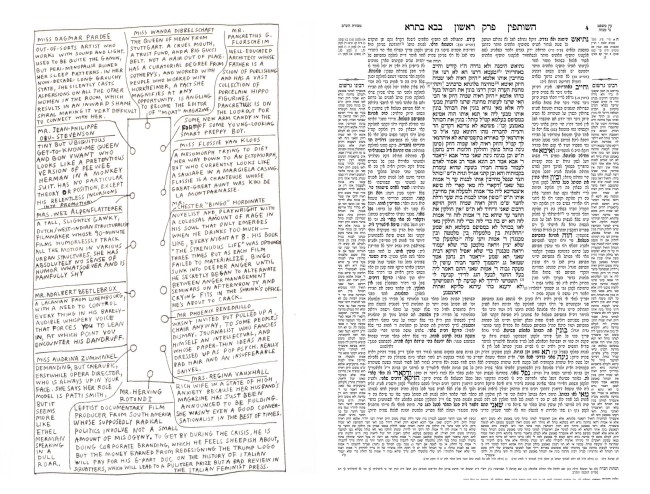
A few years ago, I got to see Amy Sillman’s hilarious “Seating Charts” at Art Basel in Miami, in which she diagrammed which art insiders would sit in which places at various faux dinner parties.  It reminded me of a project I had previously wanted to work on but never could manage (not a laziness but a logistical thing, a flaw in the plan itself.)  I saw it with my bro IS, who yesterday sent me this amazing blog post that compares Sillman to my absolute favorite, the Shulchan Aruch (and the Talmud)!

SO MUCH TINY WRITING!

SO MUCH TINY WRITING!


A brief excerpt of the post:

I am not the first to compare Jewish Law to dinnerware, in fact the preeminent code of Jewish law was called The Shulchan Aruch (Hebrew: שׁוּלחָן עָרוּך‎, literally: “Set Table”) authored in Safed by Sefardic scholar Yosef Karo in 1563.   Ashkenazi Jews follow rulings of Moses Isserles whose glosses to the Shulchan Aruch are widely referred to as the mappah (literally: the “tablecloth”).  Commentaries on the work include Peri Chadash (“New Fruit”) and Megadim (“Dainty Fruit”) culminating in the early 20th century work  Aruch HaShulchan (Hebrew: ערוך השולחן) (“the table is set”)  which attempts to remaster the original recipes of the overly processed rulings of the Shulchan Arukh and identify their sources.


I HATE NATHANIEL RICH

October 9, 2013

A few years ago, a former friend of mine, who enjoyed vegan baking and falling for attached men, developed a serious crush on writer/Frank Rich spawn Nathaniel, he of the title of this post.  She dragged me to some event that he was co-hosting and awkwardly hung around the table where he was signing books afterward and introduced me, though I seriously doubt Sir Rich remembers it.  Since then, I’ve definitely imagined a familiarity that simply doesn’t exist, and tracked his career in ways that I perhaps wouldn’t have had I never shook hands with the dude.  I’ve read his writing when it is sent my way, noted releases of his novels, and cringed with envy when I heard his voice on This American Life.  But this week, my jealousy reached new peaks when a friend forwarded me the oral history he did of the Chelsea Hotel for Vanity Fair (also, please note my prediction that oral histories are the new listicles is TOTALLY COMING TRUE!) and of course I was beside myself.  MY Chelsea Hotel?  The place I spent a paycheck to stay in even though it was ten blocks away from where I lived?  The building I sometimes stroked as I walked by (en route to nowhere) just because I loved it so?  The hotel that––yes, I know––has turned me even in these sentences into a bumbling cliche and puts me firmly in the derided category of “poseurs with artistic pretensions,” to quote R. Crumb.

A snippet of the oral history, which can be read in full here.  This isn’t the best bit of it all––just want to remind myself to look up the work Isabella Stewart Gardner the younger, and also Busby is my buddy IRL.

“GERALD BUSBY: There were rooms kept aside for black-sheep children from rich families, who paid Stanley to babysit. The most auspicious of these was Isabella Stewart Gardner’s grandniece, who had the same name: Isabella Stewart Gardner. She was an excellent poet—a poet laureate of New York in the 70s—and married to Allen Tate. She was also mad as a hatter, a total masochist, alcoholic. She’d get drunk and meet someone and he’d take her up to her apartment and fuck her and beat her up and steal something, and then she was totally happy.”

So after I get over my sadness that I didn’t get to work on this project, I open up my latest issue of Harper’s  and what do I find there but a cover story by Rich about a dude who INFILTRATES CULTS, which I would a) love to do and b) have planned on pitching a reality show series about for ages.  This guy has all the motherfucking luck.

Oh, and in case you haven’t gotten this already, I don’t actually hate Nathaniel Rich even a little.  He seems like a good dude and an excellent writer, and I think if you can milk nepotism, why not take advantage?  I’m just jealous of his subject matter, obviously.

Anna Nicole, The Opera

September 24, 2013

Hated by New York Magazine and beloved by yours truly, Anna Nicole has been the biggest ticket in town since… well, Tuesday.  Herewith, the synopsis of Act I.  I won’t give away the ending, I promise!

Scene Zero: A three-bar overture

Scene One: America Sings

Anna is introduced.  She is fabulous.  And eccentric.  Fabulously eccentric.

Scene Two: “No! It’s Mu-hay-uh!”

Anna establishes one thing: she was born in a town called Mexia, pronounced “Mu-HAY-ah.”  This phonetic problem is the town’s main claim to fame and is incorporated in the town’s motto: “A great place no matter how you pronounce it!”  Anna wants out.  Big time!

Scene Three: “Hey We’re Family!”

We meet the family: most importantly, Anna’s mother, Virgie, and her son, Daniel.  Mom Virgie frowns at Anna’s life but her heart always melts for the cataclysmically cute Daniel.  Daniel is the love of Anna’s life.  The Lawyer Stern is momentarily introduced and then pushed off stage.  Anna, divorced and broke, heads for the bright lights of Houston.  Faced with the prospect of low-wage jobs and grunt work, Anna chooses an alternative route.

Scene Four: Falling in Loath Again

Anna enters the world of the “Gentlemen’s Club.”  The earning potential is vast.  All cash, no IRS.  But there is a problem…

Scene Five: Life Implants

Problem solved: breast implants.  Up side: more attention, more cash.  Down side: chronic back pain for the rest of her life.  On returning to the Gentlemen’s Club, Anna soars.  And she meets the holy of holies: the Rich One.  We meet the oilman, J. Howard Marshall II.  Marshall falls under her spell.  He wants Anna.  He takes Anna.  Her life is transformed.  She asks for a ranch.  But… there ain’t no such thing as a free ranch.

Scene Six: American Dreaming

Anna gets the ranch but it didn’t come for free.  The world opens up for Anna.  With the prospect of unlimited cash, she seethes with ambition.

Scene Seven: Marriage in the White Dove Chapel

Anna marries J. Howard Marshall II.  Virgie (Mom) explodes with rage and disgust.  No one listens.  The Lawyer Stern gives Anna his card.  Daniel brings Anna her pills and she looks forward to a life of wealth––and chronic back pain.

If It’s Not Fun, Why Do It?

September 17, 2013

ID: omg i had brunch at the scientology center yesterday

MK: why did you do that

ID: two reasons

1. $12, all you can eat

2. kicks

MK: i’m only partially convinced

ID: hahaha

it’s at the celebrity centre in la

MK: i drove by that when i was there

looked huge and terrifying

ID: it was pretty nuts

they had some great posters

depicitng the 17 stages of enlightenment or… something like that

MK: only 17?

that’s ez!

City-Based Syndromes

September 16, 2013

I haven’t posted in a WEEK, which is like, normal for every blogger in the universe but criminal for me.  In any case, it’s been a hectic few days, which included: my first visit to the Chateau Marmont (wee!), brunch at the Scientology Celebrity Centre in Los Angeles, Yom Kippur at a ghetto Days Inn outside LA, and the discovery of these two gems.

Jerusalem Syndrome “is a group of mental phenomena involving the presence of either religiously themed obsessive ideas, delusions or other psychosis-like experiences that are triggered by a visit to the city of Jerusalem. It is not endemic to one single religion or denomination but has affected Jews, Christians and Muslims of many different backgrounds.

“The best known, although not the most prevalent, manifestation of the Jerusalem syndrome is the phenomenon whereby a person who seems previously balanced and devoid of any signs of psychopathology becomes psychotic after arriving in Jerusalem. The psychosis is characterised by an intense religious theme and typically resolves to full recovery after a few weeks or after being removed from the area.”

Paris Syndrome  “is a transient psychological disorder encountered by some individuals visiting or vacationing in Paris, France. It is characterized by a number of psychiatric symptoms such as acute delusional states, hallucinations, feelings of persecution (perceptions of being a victim of prejudice, aggression, or hostility from others), derealization, depersonalization, anxiety, and also psychosomatic manifestations such as dizziness, tachycardia, sweating, and others. Similar syndromes include Jerusalem syndrome and Stendhal syndrome.  Japanese visitors are thought to be especially susceptible.”

I’m currently going to work on a short film about a little old Japanese man stricken with Paris Syndrome.

Is There Any Bigger Badass Than Susan Sontag?

August 23, 2013
Found while researching "Waiting for G-dot..."

Found while researching “Waiting for G-dot…”

Dream Assignment: Cataphiles!

August 20, 2013

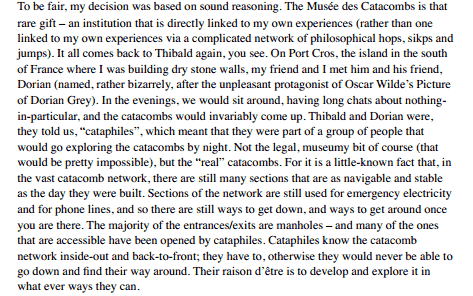
From a friend’s (currently) unpublished memoir:

Read me.

Read me.