I had a dream the other night that the below stunner, Jane Friedman, who is well known in the publishing world, was trying to eat me.

And I woke up screaming and covered in sweat.
I had a dream the other night that the below stunner, Jane Friedman, who is well known in the publishing world, was trying to eat me.
And I woke up screaming and covered in sweat.

Drew a graph of my brain.
So I have an essay published in an e-forum somewhere (let the scavenger hunt begin) and I must admit I’ve been reading the comments and basing my self-worth heavily on the reactions of the readers, and there’s one comment that knocked the wind out of me:
Gabriella on January 4, 2012 at 1:18 am
I am quite speechless. This is just raw. Really looking into the abyss, I’ll be damned if I didn’t get a bit of vertigo.
GABRIELLA, WHERE ARE YOU?! It’s so clear that you totally understand me, and we were meant to be together! Let’s shut ourselves up in my attic lair and read dark Russian literature all day and switch to French surrealism at night. You can be the Didi to my Gogo, and I the Raskolnikov to your Sonya. Only to you can I reveal my still-alive love of Tori Amos, and only to me can you talk candidly about the abyss. I been there, girl.
My beloved responded to my not-so-subtle hints about wanting the beautiful book Atlas of Remote Islands by Judith Schalansky and bought it for me for Christmas. At the end of today, one in a string of many during which I’ve acutely felt the world impeding on my inner life, I am blissfully alone with this text, reading about these far-flung, windy places and imagining what it is to be one of 384 people who live on an island in the middle of a vast ocean. It is comforting for me to think of things so small and solitary. Unlike Ms. Schalansky, though, who gives her book the subtitle Fifty Islands I Have Never Set Foot On and Never Will, I am not willing to rule out the possibility of traveling to these desolate places, if only just to here waves breaking on dead silence. What better soundtrack to a slumber?
ST. KILDA ISLAND
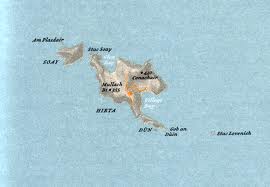
Her little illustrations are so charming.
St. Kilda –– you don’t exist. Your name is just a faint cry made by the birds that make their home on the high cliffs at the furthest edge of the United Kingdom, beyond the outermost of the Outer Hebrides. Only when a north-east wind prevails can the voyage even be attempted.
There are sixteen cottages, three houses and one church in the only village on St. Kilda. The island’s future is written in its graveyard. Its children are all born in good health, but most stop feeding during their fourth, fifth or sixth night. On the seventh day, their palates tighten and their throats constrict, so it becomes impossible to get them to swallow anything. Their muscles twitch and their jaws hang loose. Their eyes grow staring and they yawn a great deal; their open mouths stretch in mocking grimaces. Between the seventh and the ninth day, two-thirds of the newborn babies die, boys outnumbering girls. Some die sooner, some later: one dies on the fourth day, another not till the twenty-first.
Some say it is the diet: the fatty meat of the fulmars and their eggs smelling of musk that make the skin silky smooth but the mothers’ milk bitter. Or that it is a result of inbreeding. Yet others say that the babies are suffocated by the smoke from the peat fires in the middle of the rooms, or that it is the zinc in the roofs or the pale pink oil that burns in the lamps. The islanders whisper that it is the will of the Almighty. But these are the words of pious men. The women who endure so many pregnancies and bear so few children who survive the eight-day sickness remain silent.
On 22 June 1876, one woman stands on the deck of a ship that is bringing her home. Like all the women of St. Kilda, she has soft skin, red cheeks, exceptionally clear eyes and teeth like young ivory. She has just given birth to a child, but not at home. The wind is blowing from the north-east. Long before she can be seen from the shore, she lifts her newborn high in the air.*

Village Bay

A difficult climb.
*The writing in this book is so eerie, oftentimes the stories seem hard to believe, so if I were you, I wouldn’t take this as straight history until yours truly fact checks it and gets back to you. Word to the wise…
So I am decidedly apolitical, but this picture, beneath a Times headline “South Carolina Voters Weigh Priorities,” caught my attention for just a moment before I realized that sadly, the article wasn’t about fat people voting.

I mean, cmon now...
Do you think that the photo editor has a sense of humor? I do hope so, because G-d knows, politics would be way more exciting if people in the arena were funnier.
I’ve been really busy procrastinating and eating food with my boyfriend and therefore have been terrible with my blog. For me, this means no “substantial” posts in a week, whereas I know I am (*brushes dirt off shoulders*) slightly more diligent than most “hobby” bloggers. (Hloggers?)
Any fuck, I’m working on some really big, original pitches to the Kardashians, Vice Magazine, and an in-depth piece about the life of Britney Spears (a hagiography of sorts) but in the meantime, here’s a little snippet of an interview with one of my favorite artists, Petah Coyne. The whole piece is worth reading, but here’s the part that I think about probably seven or eight times a day:
LT In an early piece, when you’d first moved to New York, you hung dead fish from trees around the city. Looking at photographs of the dead fish, I think, Here’s a new girl in town, walking around a strange city, seeing dead fish in stores. It’s as if you identify with them. You begin saving them, collecting them. It’s odd, because you’re collecting corpses and trying to keep the corpses from decomposing. What did you put on them?
PC We put Rhoplex on them, which didn’t preserve them. Then we used polyurethane, but if there are any air bubbles in it, the maggots still get in.
LT You hung dead fish from a tree in front of a house in the suburbs. Such a weird thing.
PC Do you think so?
LT The idea that some suburbanites would like to awaken to dead fish hanging from trees in their front yard.
PC I never assumed they wouldn’t.
LT That’s what’s strange. But you had to get the fish out of your loft; they were a health hazard.
PC After five years of living with decomposing dead fish…. But perhaps first we could talk about the fact that I almost always work intuitively. My mother trained me to trust my instincts. As I get older, I trust them more. Women have this instinctual ability to know stuff we shouldn’t know. I don’t know how. When I arrived here in New York, I worked at Chanel during the day. I did their in-house advertising. It was the height of beauty—many of the women were having their legs operated on to make them thinner—and then at night I would go and buy dead fish. I was like an alcoholic. I’d say, I’m not going to spend another cent on dead fish, but I couldn’t resist. For me, I was saving the fish from being eaten by someone. I was going to give them a better send-off. And in addition to all that, I was also working with people who were terminally ill.
LT You were working at Chanel, and you were working in a hospice?
PC I was going to Boston every other weekend. I worked for a physician there. My job was to go in and talk to his patients and listen to them, because their families couldn’t, it was too painful. I was also looking for something that was more real than what I was seeing in the galleries. I couldn’t relate to it, and I couldn’t relate to Chanel.
LT What year was this?
PC This was 1978, 1979. The gallery situation was so intimidating. Susan Lubowsky Talbott, who’s now the director of the Des Moines Art Center, also lived in this building, and she kept saying to me, “Just keep working. I don’t understand what you’re doing. And don’t try to show this stuff, nobody’s going to want to see it.” So for five years, I worked by myself. Susan kept saying, “Just keep going.” In Boston, I was working with people who’d been given a month to live. They could opt for surgery, and I could often watch the surgery, which was fascinating. There was a mourning, and other rituals similar to both Catholicism and Japanese culture, both multilayered and complex. Just as you left one layer unscathed, what you were presented with wasn’t the insight you wanted to attain, but a dozen new thoughts and questions. I was so moved by what people confided to me. The dead fish would then be as close as I could get to their passing. Many of the patients died. A few didn’t. I tried to figure out why. What was their strength? Their power? I was trying to put those thoughts and energy into my work.
Text from ID to IS: Should I write an essay on the ouevre of James Franco or would that suck because I’d actually have to read his books?
Response: That would suck. You’d have to read the word “gaze” a lot. But you could tease out the double entendre of his homosexuality gaze/gays. But that sucks, too. So, no.
ID: Dammit, I thought I had my first good idea in a while.
“How can I do Ibogaine if I’m not a heroin addict?”
Daytime elaboration: it’s a drug that provides what many call a “massive brain rebooting.” Kind of like the master cleanse for the psyche. I could totally use that shit.
I recently read a book that I picked out because it was rated as “Highbrow” and “Brilliant” in New York Magazine‘s Approval Matrix, which is super embarrassing and would likely lead to this blog post and perhaps even me, as a Cultural Figure, being labeled Highbrow/Despicable (because let’s face it, while I may certainly be a twat much of the time, I am by no means “lowbrow.”) This book, entitled 420 Characters by author and illustrator Lou Beach, contains a bunch of mini-“stories” that Beach originally posted as Facebook statuses. This book will certainly be touted as one of the early examples of the genre that yours truly has dubbed “Twitterature.” The Twitterature genre will continue to grow –– of course, only a matter of speaking –– now that the seedlings of Six Word Memoirs (Smith Mag, beloved by gift book publishers) and seven word stories (Opium Magazine) have been planted.
What do I think of Twitterature, though? Glad you asked my opinion –– I love to give it. Sometimes the tiny pieces can incite intrigue and imaginative wanderings, but many times they fall flat to me, as they seem born of a writer’s laziness to refuse to construct a plausible and/or poetic ending. In other words, the writers give in to their natural human predilection to indecision, a micro-sin under the “sloth” umbrella.
So, while Beach’s book was meh entertaining sure whatever, there were only two pieces that I found memorable, both of the slap-my-thigh-and-call-me-Sally funny variety. Here we go:
“I don’t care much for plucky heroines. I do have a soft spot for hard types and waitresses and divorcees. Which is why I like Reno, I guess. I can hopscotch and hobnob, bourbon in hand, from lounge to coffee shop to poolside. The Rogaine is saying, ‘Harvest time!’ and the Viagra fills me with that can-do spirit. I’m on fire, baby!”
…
Okay so maybe there was only one that stuck with me that way. Here’s another I liked, though, also sort of funny:
“Ann O’Dyne, nurse, had healing hands, wee mitts sprung from the cuffs of her crisp white tunic. Her voice was gold, a brook in the meadow. It washed away fear and anger, discomfort and pain. She was the pride of the ward, the whole hospital, the surgeon’s pal, the patient’s savior. At home, her feet hurt, she drank, slept with a butcher, called talk-radio programs, ranted about illegal immigrants and the Jew-run media.”
And another I sort of like although it’s a bit cheesy:
“Kiss me a question, ask me again with your eyes and I”ll answer with my fingers, trailing reasons down your spine. There’s a theory behind your knees and a postulate in that sweet spot on your neck, and I’ll respond to your query with a smooch and a holler, roll you up against the sink and wash your hair, make love till the plates fall of the shelf.”
Now, here is me, wishing I were Lou Beach (subtitle: resisting making fun of the trend by declaring the new hot thing ONE WORD LIT and writing my masterpiece THE, and waiting for all the critics and readers to declare it “eerie” and “expansive”):
Me, Wishing I Were Lou Beach
Timmy Simons tried to brush the gravel off his scraped knee but some of it stuck in the puss. He winced when he looked down at the raw, red patch. Crouched on the ground, Jimmy glared at Leland as his neighbor rounded third and lifted his arms above his head triumphantly. Leland who could do a back dive without flinching and who third grade girls thought was cute even though Leland was in second grade. One day Jimmy would get Leland. Jimmy had seen Leland’s mother undressing at night. He knew the secret.
I’ve been too tired from eating too much peanut butter honeycomb pie (ridiculously amazing) and so I have dropped the posting ball! I have about a billion ideas, though, so here’s a funny face (from my 25th birthday party) to tide you over:
Happy mustache!
 Itinerantdaughter's Blog