In order of how much I wish they weren’t.
7. Anne Archer
She is the sweet brunette mother to Glenn Close’s psychopathic blond stalking opera lover in Fatal Attraction, and I just want to root for her in all things, but I can’t if she is a Scientologist –– and not only is she, but her son, Tommy Davis, is the head spokesperson for the whole shebang. In the novel-length article on screenwriter Paul Haggis’ defection from the church in The New Yorker, Archer actually sounds reasonable and NICE, and then she goes and does something like “describe Hubbard as ‘an engineer’ who had codified human emotional states, in order to guide people to ‘feel a zest and a love for life.'”
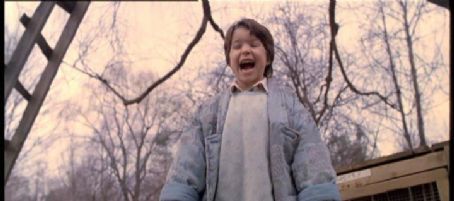
Wait… who am I kidding? Archer is cool, but the real Fatal Attraction cast member I’m rooting for is the adorably transgendered Ellen. “RABBITS!” Whatever happened to that little muffin?
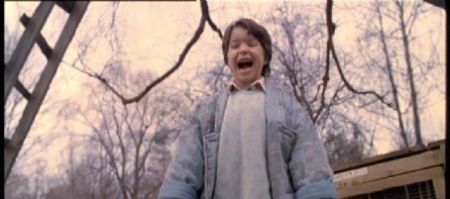
I’m guessing this is when she discovers Glenn Close slaughtered her bunny.
[Digression: ANSWER! Here’s her bio from IMDB:
“Discovered at an open call at age six, Ellen was chosen from well over a thousand children to play Michael Douglas’s daughter in Fatal Attraction. She continued acting full time until she left for a VT boarding school at age 15. After graduation, Ellen took some time off to travel, and later began studies in glass at an art school in Oakland, CA. Her mother Anne, lives in New Rochelle, NY, her father Bob, step-mother Lorrie, and 10-year old sister Elena live in Roslyn, NY, and her 26-year old sister Amy lives outside Denver, CO. Ellen has little plans to get back into acting, though will always reflect fondly on her past achievements.
According to another website, she is an “account executive” and while she wishes she could be in Show Biz, she has no immediate plans to return to it. “Plus, it’s kind of cool to be considered a has-been. And kind of sad, too.” Spoken like a true burn out. Remember, Ell, it could have been worse –– you could have tried to clear the difficult puberty hurdle in show business and, in a moment of desperation, visited the Celebrity Center and taken a few courses and before you could blink, you’re rapping about Thetans to your closeted gay husband.]
6. Elisabeth Moss
Like most everyone these days, I enjoy me some Mad Men. Now of course, it would be much more devastating if Jon Hamm were a lover of Xenu, but it’s still sad that Elisabeth Moss, who plays one of the most interesting and multidimensional characters on the show, is just that. And it sucks because Moss is just so good as the kind-of-unattractive, dissatisfied but whip-smart copywriter Peggy Olson, and when I think about her talent, I start to wonder if maybe her ability to act has something to do with her faith and then I get the willies and turn off the TV and go shower. Some other blogger (not worth it) wrote something along the lines of, “It doesn’t change the way I view her or the show” but frankly, I’m either just not that good at compartmentalizing or Scientology is just that toxic that it ruins everything it touches in even the slightest of ways. So, in the name of enjoying television more, I suggest Moss consider Zen Buddhism.
5. Rita Wilson
I know! I know! Crazy, right? There isn’t much out there on her affiliation, but here’s my proof: a few years ago, my family friend, who works as property master on movie sets, had the privilege to work on the cinematic masterpiece Old Dogs (I think.) Now, Kelly Preston, a well known Scientologist, is in the movie, and so is Rita. They were apparently BFFs. At Christmas dinner the year the movie was being made, my family friend regaled us with a story: one day, they were shooting a scene in which someone was supposed to close a car trunk on Kelly Preston’s hands. They had somehow rigged it so that there was a gap her hand could fit into so that the door wouldn’t break her fingers, but Kelly didn’t properly gauge her finger placement and so BAM! Trunk comes down on fingers.
“Now what you may not know about Scientology,” my family friend continued, “is that at a certain high level, they believe they can heal people’s pain by touching or by waving their hands over the wound, and so Rita Wilson comes frantically running up the hill and yells at everyone to BACK OFF and begins waving her hands over Kelly Preston’s fingers and looking deeply into her eyes.”
And this aspect of Scientology has some back-up, also in the (now infamous) Haggis article:
“Brolin says that he once witnessed John Travolta practicing Scientology. Brolin was at a dinner party in Los Angeles with Travolta and Marlon Brando. Brando arrived with a cut on his leg, and explained that he had injured himself while helping a stranded motorist on the Pacific Coast Highway. He was in pain. Travolta offered to help, saying that he had just reached a new level in Scientology. Travolta touched Brando’s leg and Brando closed his eyes. ‘I watched this process going on—it was very physical,’ Brolin recalls. ‘I was thinking, This is really fucking bizarre! Then, after ten minutes, Brando opens his eyes and says, ‘That really helped. I actually feel different!’ ‘ (Travolta, through a lawyer, called this account ‘pure fabrication.’)”
The thing is, Rita Wilson is sort of scarily Botoxed now, and I don’t really care for her all that much, but if she’s a Scientologist that means Tom Hanks is probably a Scientologist, and like everyone else in the world I think he just seems so great and “normal” (the highest compliment one can give a movie star) and like he’s not repressing any homosexual tendencies (NOT THAT THERE’S ANYTHING WRONG WITH THAT, but if Tom Hanks were gay, I’d just want him to live his tye-dyed-hot-pants reality!)
4. Jason Lee
Just like most brainy and self-conscious adolescent girls growing up in the age of Kevin Smith, I had a minor thing for Jason Lee. He was always the friend of the token hunk, which I related to as I always had a really hot best friend, and he had a quick wit and a cute little gleam in his eye. Who could forget his deep and philosophical explanation of rock ‘n roll in Almost Famous while Billy Crudup produces a few head-turning twangs on the guitar in the background and steals William Miller’s attention? “Some people have a hard time explaining rock ‘n’ roll. I don’t think anyone can really explain rock ‘n’ roll. Maybe Pete Townshend, but that’s okay. Rock ‘n’ roll is a lifestyle and a way of thinking… and it’s not about money and popularity. Although, some money would be nice.” Lee, desperate to be heard, always the dorky best friend. A tragic figure, really. Unfortunately for me, I think I may have fucked up this list –– I forgot Lee starred in My Name is Earl for four years (!!!) He and Elisabeth Moss should definitely switch spots.
3. L. Ron Hubbard
I mean, honestly, the guy was a fucking genius –– how many people can make statements like, “The money isn’t in writing books, it’s in starting religions” and afterward CONTINUE to attract followers and make money? Fucking ridiculous.
2. Beck
This one’s a no brainer. Everyone’s still and constantly brokenhearted over this poor virtuoso, probably the single person on this list you could say was “cool,” and the only consolation we seem to have is that he was raised a Scientologist (mom was Warhol star Bibbe Hansen, dad Canadian musician David Campbell), may have attended a Scientology-run elementary school, and thus didn’t have much of a chance. Beck has only once really gone on record about his involvement with Scientology (New York Times, 2005, in which the journalist writes that he’s so aggravatingly polite “his courtesy acts like a moat”) and he did so in such an incredibly ineloquent way, but again, we’ll excuse it as sometimes savants lack skills outside their chosen fields. Regardless of your past, Beck, hear this: you’re the one we want the most!
Although your mom seems pretty cool, too…

Andy Warhol, Edie Sedgwick and Bibbe at Max’s Kansas City, 1965. I never get to do anything cool.
And finally…
1. Jett Travolta
For his sake.
Too soon?