Hair of the Dog, Part I

February 10, 2017

This essay is based on a true story, although I cannot guarantee that the details are accurate or in chronological order. I was very drunk while it was happening, and while writing it, and I’m also wasted right now. WKDC rules and an update on this year’s show will be found at the end of the piece.

In mid-February of 2013, I was a week late handing in an article about online dating––me, who had never even had a Facebook profile––and so naturally when my old friend from high school texted me to ask what I was up to that evening, I responded with, “Probably nothing.”

“Wanna come over for Westminster Dog Show drinking game?”

“When should I be there?”

As I walked down a blustery Union Avenue towards D’s apartment, I thought with no small degree of pride of the wonderful achievements in drinking games he and I had managed over the years. From Lifetime movies to the Academy Awards, while people watching at airports, attending garish weddings, or imbibing at hipster bars, we’d managed to find a way to compete our way to brown out through nearly every situation a twenty-something might encounter. Some of our more notable experiences included an ill-fated attempt to drink every time a contestant on The Bachelor cried (we were incapacitated eleven minutes into the show) and an ambitious scheme to create a set of rules that could be applied to any television show. ever. made. And of course, our piece de resistance: Intervention drinking game. After watching probably twenty episodes of A&E’s classic addiction horror show, we decided that the structure was so cathartically formulaic, the horrors so neatly and relentlessly recurring, that it begged for ritualized, boozy accompaniment. We purchased a domain name––it’s practically a miracle interventiondrinkinggame.com was still available––and crafted a list of the rules: one drink for an obligatory family gathering, for every overdose, for a parent who looks weepily into the camera and says that the addict was once “such a happy baby” (life lesson: pray for mediocre children––the adorable prodigies always get kidnapped or hooked on heroin.) We bumped up the ante to two shots for when an addict is allowed to get a fix before heading off to New Beginning Sunrises Center or wherever they’re going to dry out. Finally, to make things a little more interesting, we added a stipulation in which each individual “contestant” could make all the other players drink one time for anything he or she deemed absurd enough to be worthy. We dubbed this rule “Calvinball,” after the anarchic game played by Calvin and Hobbes. Addicts do some pretty bonkers stuff, so there was ample opportunity to take advantage of this rule. Constructing drinking games, after all, is a true art form, one that requires a sense of delicate balance: on the one hand, you must choose things to drink to that occur frequently enough that you can actually get drunk, but not things that happen so often that it isn’t a challenge trying to spot them.

When I arrived at D’s apartment, he was drinking cheap whisky from a fancy crystal tumbler; he poured me three-fingers’ worth as the broadcast came back from a commercial for WEN by Chaz Dean dog shampoo. We were midway through the Toy Group, the mostly-loathed category that encompasses canines that usually look like rodents or footstools (see: the Pekingese). With a few exceptions, these are the types of dogs you consider kicking on the street, or the ones that shiver constantly without teeny sweaters. D started outlining what he had accomplished the previous year with his roommate Kevin, whose boyfriend was also named Kevin.

“We thought, like, if the owner’s body is floppier than the dog’s… ”

I almost snorted my drink through my nose.

“… and one drink for anyone who’s actually well dressed.”
“How often does that actually happen?”

“Like twice in two nights. When the judge is overly interested in the dog’s anus.”

“That’s gotta be a technical thing.”

We both took a slug of our whiskies.

“Every time someone’s wearing orthotics?” I suggested.

“That’s way too intense.”

I’ll admit that during the brainstorming session, we weren’t exactly drinking according to our proposed rules. But that’s the nature of the drinking game, one played by serious imbibers, in any case: yes, you drink when a designated thing happens––like when the dog and the owner resemble one another, we decided––but really, you’re drinking for keeps, so you sip even when nothing of note is happening. Thus, by the time the surprisingly adorable Banana Joe, an Affenpinscher (also known as a “monkey terrier”) won the Toy group, which couldn’t have been more than fifteen minutes after I arrived, my whisky was already depleted and I had moved on to a tall Narragansett. My sense of the “delicate” art of rule finding began to waver––were “smushed faces,” like the one little Banana Joe had, or powder puff tails too common, I wondered aloud? By the time the Non-Sporting Group–-a kind of catch-all category that includes everything from wee Boston Terriers to cinematically-beloved Dalmatians––was halfway through, I was halfway through my third Narragansett, and I had written a number of barely intelligible reminders for us on a piece of paper splattered with rapidly drying drops of beer:

How many sequins is too many sequins?

when the dog has more Facebook friends than you

Fifi the Doberman

CANKLES????

As the first night of competition wrapped up, we had twenty potential rules, with four that seemed so good they would almost certainly make the final cut (file “handler tattoos” here.) The panel of commentators, as unintentionally hilarious as Christopher Guest’s trio in Best in Show were intentionally so, began to talk about the usual post-game ritual for the show’s overall winner. “Best in Show always goes out for a nice steak after the big win,” one said.

“Oh. My. God. How cool it would be to go eat steak with that dog? Like, does someone cut it up with a fork and knife?”

“You should totally go.”

Through one blurry eye, I rapidly typed an email to one David Frei, who was listed as the press contact on the website (I later realized this guy was also the announcer, whose voice had become, according to the New York Times, “as familiar as a woof.”) “Thanks so much, and I hope you’re enjoying this likely stressful but exciting few days!!!” (I always got a little loose with the punctuation when drunk.) D and I both agreed I should just show up at the Garden the following evening and talk my way into the press room, but I was far too hung over to make it to midtown when the time came.
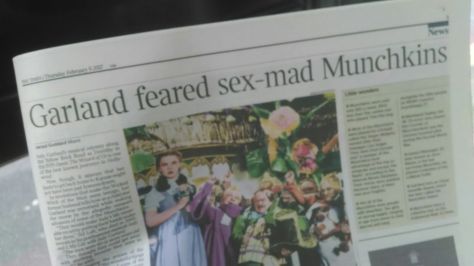
Presented Without Comment

February 9, 2017

ID:         img-20170209-wa0005

[My former boss] used to talk about this all the time

How the midgets were always having orgies on set

KM: What the fuck?

I need to know more

How did Phil know?

ID: Liza Minnelli told him

They had a fling

KM: Whoa, both of those sentences are amazing

For Immediate and Widespread Release

February 8, 2017

On behalf of the International Association of All Museums (Whether They Signed Up Or Not), we’d like to announce that the first Wednesday of every month will be official NO PHONE DAY at every museum in the world.  On this hallowed day, all museum visitors will be asked to arrive sans phone, or will  be asked to check their phones at the doors.  No exceptions will be made.  Visitors will be encouraged to look at the art using simply their eyes and nothing else.  The museums will be returned to their original states as places of contemplation and reverence, rather than as spots in which one might frame the perfect selfie in front of a Van Gogh.  Sketching will be encouraged, as will quiet and thoughtful conversation on the nature of art and the lives of the great artists of history.

Rules will be strictly enforced, but we also know that some individuals are so attached to their devices that we will perhaps miss a few.  If you are considering sneaking in your iPhone, please consider that you have around more than 300 days in the year to be a narcissistic douche bag.  As difficult as it may be, why  not attempt to be considerate of the small amount of time that those who are sensitive to watching your insufferably self-centered behavior have for themselves?

I <3 Experts

February 4, 2017

Michael Gove, British gnat, famously said back in the time during Brexit campaigning that Britons were “tired of experts.”  With the election of Donald Trump, the era of the average asshole has been officially heralded.  But I was thinking the other day: I bet there are plenty of instances in which even Gove himself would prefer an expert over an amateur.  Here are just a few:

Cardiovascular surgeon: who would you rather tinker with your ticker, a real doctor or a guy who just believes he has a feeling for it?

Airline pilot: or helicopter pilot.  Or submarine captain.  Okay, so basically any large vehicle operator.

Professor of Ancient Greek: if you need to learn it, why not learn from the best?

Criminal defense lawyer: Never know––he might be in need of one at some point.

Translator

Bomb detonator: this one feels *too close* yet undeniable

Lion tamer: I guess if you find yourself inexplicably dropped into a lion enclosure at the zoo…

Hit man

Skyscraper designer: would you be chill living in a penthouse built by a child, for example?

DON’T MAKE ME GO ON, GOVE.

Outsource Voice

January 30, 2017

I was thinking of entering a writing contest I briefly read about, and then I visited the judge’s website, and his bio is so bizarrely and poorly written that I decided, um, no.  It reads as if perhaps someone else––someone who isn’t a native English speaker––wrote it, and then Clare just never edited it?  Or a bot wrote it?  In any case, it’s not a crime against humanity or anything, just very bizarre to see an “award-winning author” allow such a shoddily written summation of his credentials to be out there.  I was going to redact the name but that was just too much damn trouble.  Disclaimer: he does seem to be a good writer and also accomplished.  It’s not him I object to; it’s this Google Translate bio!

Horatio Clare is not only an excellent multi award-winning author but a radio producer and journalist too. He was born in London in 1973. He spent his childhood on a hill farm in the Black Mountains of south Wales with his brother Alexander. They both grew up there.

Before reading the English at the University of York, he attended the United World College of the Atlantic and Malvern College.

He worked as a producer on Front Row, Night Waves and The Verb at the BBC. He is the writer of two memoirs, Truant and Running for the hills.

A Single Swallow and Down to the Sea Ships are the pieces of his writing that he wrote about travel and nature.

He is the writer and editor of Sicily through Writer’s Eyes. A book named “Orison for a curlew” was an excellent piece of his writings that was published in 2015, in which he combined the travel and nature topic altogether. Aubrey and the Terrible Yoot an acclaimed children’s book was also published in 2015.

The experiences of his childhood are described in his first book, “Running for the Hills” (The best seller).

His second book Truant was published in 2008. His third book “A Single Swallow” (Following an epic journey from South Africa to South Wales) was published in 2009.

His first children book,” Aubrey and the Terrible Yoot” was published in 2015 by Firefly.

Clare wrote and edited “Sicily through Writer’s Eyes”, which was an anthology of writings about Sicily, and it played the role of a contributor to the collections Red City: Meeting with Remarkable Muslims and Marrakech through Writer’s Eyes.

The Sunday times, Financial Times, The Observer and Vogue, The Guardian, The Sunday Telegraph, The Sunday Times, The Daily Telegraph, New Statesman and the Sunday Times are the platforms where his Journalism appeared.

He won the Somerset Maugham Award his best-selling masterpiece “Running for the Hills” in 2007. He was also shortlisted for another award named Sunday Times Young Writer of the Year Award in the same year for the same masterpiece.

Later on, he was shortlisted for Dolman Best Travel Book Award for “A Single Swallow” in 2010. And in the same year, he won the Foreign Press Association Award for his travel feature 2010 “Rock of Ages – Ethiopian Highlands”

In 2015 he won the Stanford Dolman Travel Book of the Year award for Down to the Sea in Ships.

In 2016 he wrote a book for Children name “Aubrey and the Terrible Yoot”, which later on was announced to be the best book of the year and which made him win the Branford Boase Award.

These are the achievement that made him become the excellent author of the era. And he’s an inspiration for the present writers.

That Thing

January 23, 2017

where you are waiting for a table at Russ and Daughters in the Jewish Museum and, bored, you go to take out Portnoy’s Complaint but stop yourself by thinking, “Now this is just a step too far, even for me.”

Good Conversations Yesterday

January 20, 2017

KM: I’m at [redacted], which is usually a good place to work.  But right now [name of famous writer, redacted] is standing three feet away from me, trying to take a selfie in front of the library.  It’s been going on for almost five minutes.  I’m like, “Can you stop being both annoying and incredibly successful RIGHT next to me???”

ID: Ugh!

ID: I think I would have a hard time [at said redacted location] just for being surrounded by people so successful.

ID: #3 on my list of “neuroses to shed in 2017”

KM: No joke.  She’s still doing it.  I think it must be for Snapchat or a video because she keeps saying “books are magic.”

ID: HAHA

KM: She is remarkably not embarrassed by this.  She’s said it easily 20 times.

KM: Just chipping away at this proposal while this bestseller Snapchats next to me.

***

ID: I straight up don’t believe in [redacted]

AL: Nope.  Fake news!

ID: HAHAHAH

ID: From now on whenever anything I disapprove of comes up I’m just going to yell, “Fake news!”

AL: My friend said her 11-year-old now just yells that at her whenever he doesn’t want to do stuff.

New Hobby

January 18, 2017

I think my new favorite hobby is reading “Testimonies of Healing” from the Christian Science Sentinel. 

Diagnosed Dental Problem Healed

As I sat in the dentist’s chair for my yearly checkup, I once again heard how important it was that I make an appointment to have a root canal procedure.  I had heard this urging before at the previous appointment and the supposedly dire consequences of doing nothing.  But I had been doing something: I had been praying.  I had been affirming that my true substance was spiritual and that God was the source of my entire identity and being.

I knew that a decayed tooth was not a spiritual reality but an illusion, a false image of mortal mind.  A material operation would not dispel this illusion, and it was important to me not to simply go along with the seeming reality of matter’s illusive nature.  Now was the time to defeat this lie and to know that God was working out His purpose in me.  I left the dentist’s office, knowing I could lean on God, but I also felt I was at odds with the dentist who was urging a medical procedure.

Moving ahead a year,just before Christmas, I suddenly began to experience pain in the area of my mouth where the dentist had warned me about.  Over the next few hours the pain increased, and the side of my face became swollen.  I prayed the Lord’s Prayer right away and declared: “… as in heaven, so on earth, –– God is omnipotent, supreme” (Mary Baker Eddy, Science and Health with Key to the Scriptures, p. 17).

Encouraged, yet still in pain, I called a Christian Science practitioner for prayerful treatment.  Today, I don’t remember our conversation, but the love and confidence the practitioner expressed calmed my fear and strengthened my expectation of healing.  Immediately I felt the pain subside, and within a couple of hours the swelling decreased.  By the next day there was no sensation or evidence of the difficulty.

All was well until a couple of weeks later when the pain and swelling returned.  My first impulse was to call the practitioner back, requesting further treatment.  While preparing to make the phone call, I recalled the memory of the dentist standing over me and describing the troubled material picture.  At that point, however, I turned from pondering the memory of this diagnosis and listened instead to hear what divine Mind was communicating to me.

What suddenly and strongly came to thought was that the belief that I had a decayed tooth was a lie.  The disease had always been a mortal belief; my real substance as Spirit’s idea had never lapsed from the harmonious perfection of Mind’s creating.  Whatever diagnosis I’d received, based on the testimony of the material senses, was not the truth about my real substance or identity.

In that moment my realization of the truth was so profound that all fear quickly left and the pain with it.  Within an hour the swelling also disappeared.  It has been more than eight years since that experience, and all continues to be well.

An important lesson I learned from this experience is to be more prompt in rejecting false claims and to affirm all discordant conditions to be a lie.  As our Leader, Mary Baker Eddy, tells us, “When the first symptoms of disease appear, dispute the testimony of the material senses with divine Science” (Science and Health, p. 390).

At the time of the dentist’s examination and warning, I had been confident that any problem could be in healed in Christian Science, but I had not been immediately vehement in my rejection of the medical claim that was presented to me.  However, through this experience I have learned that it is never too late to stop and listen to the truth that is always present to meet our need immediately.


Art Not Ads

January 13, 2017

In New York, a group is embarking on a year-long project to replace advertisements with works of art.  Genius!  The only issue with it, as far as I can tell right now, is that it’s a little within-the-lines (I’d love to see more people take their Exact-o knives to billboards and getting arrested mid-painting session) and not pervasive enough.  I’d prefer that all ads were eliminated and replaced with artwork, but everyone knows I have wild visions for society…

The campaign was inspired by a giant picture of a surgically enhanced ass:

Caldwell was inspired to start the project after seeing an ad for a $1,000 Brazilian butt lift outside of her Brooklyn apartment last spring. She said, “I laughed it off at first, but the billboard was designed to make me feel self-conscious, and I got tired of it. I became determined to fill my life with art that would make people feel anything else.”

An example:

1483556444756

Reminds me of a few years ago, when I was just out of college, I saw a little piece about an artist, or something, was creating these bumper sticker type things that read, “You don’t need it,” which wannabe renegades like myself could request (for free) in the mail and then smack them onto public advertisements.  I still have my packet somewhere.  While I was walking through the underpass between the A and S trains at 42nd Street I saw these giant iPhone 7 posters, with that instantly recognizable sleek Apple aesthetic, and I thought, “That would be perfect.”  Next time.  (Don’t think I won’t do it.)

Why Her?

January 8, 2017

Just zipped through some of last year’s winning essays in the Notting Hill Editions Essay Prize (really loved “Eulogy for Nigger”) and although I was mostly besotted with Josh Cohen’s “The Incurious Rabbit,” there was one thing I found a bit peculiar.  When he talks about his analysands are struggling with often paralyzing indecision, he uses, for the every-patient, the pronoun “she.”

I can’t help making a link between this generalized cultural condition and the crisis I find recurring more and more often in my psychoanalytic consulting room, of the impossible decision.  Prospective patients come to me in the grip of an urgent yet irresolvable dilemma.  Should I stay in my unhappy marriage for my children’s sake?  Should I leave the stable job I hate for the risk of an uncertain and potentially disastrous new venture?  She appeals to me to help her extricate herself from a swamp of indecision and ambivalence.  But turning over the competing arguments in the session does little to clarify her wish or relieve her anxiety.  In fact, after a few session or many more, she might complain that she’s no clearer about what she wants and that the uncertainty has only become harder to bear.

So, either the Good Doctor Cohen is a) only seeing female patients (weird), b) trying to push back against the historical standard of always assuming every person/character/divine being whose gender is otherwise unspecified must be male or c) saying, in a roundabout way, that women struggle more with pathological indecision than men do.  Votes?